# What is BBX

#### What is BBX?

BBX is a globally leading, one-stop decentralized multi-asset trading platform. Committed to bringing top-tier global financial assets onto the blockchain through a robust compliance framework, BBX builds a solid bridge connecting Traditional Finance (TradFi) with Decentralized Finance (DeFi).

At BBX, users can directly use stablecoins and fiat currencies to seamlessly trade spot and perpetual contracts for U.S. stocks, Hong Kong stocks, and core global stock indices. Furthermore, users can deeply participate in IPO subscriptions and Pre-IPO trading of premium global enterprises. BBX is dedicated to providing global investors with secure, compliant, and borderless freedom in asset allocation.

#### Why Choose BBX?

**1. Market Opportunity: Bridging the Stablecoin Gap**

Stablecoins have become the mainstream settlement layer for digital assets, with annual transaction volumes exceeding $46 trillion. However, this massive pool of capital currently lacks a direct and efficient channel into global equity markets. BBX was created to fill this trillion-dollar market gap.

**2. Pain Point Analysis & Solutions**

BBX deeply integrates a multi-asset liquidity network, on-chain order books, and a unified account mechanism to build the first comprehensive trading infrastructure that connects stablecoins directly with global traditional financial markets.

* Breaking Down Account Barriers: Eliminates cumbersome traditional offshore brokerage account opening processes and cross-border wire transfers, providing stablecoin users with a transparent and efficient channel for global investment.
* Aggregating Global Liquidity: Spot orders are routed directly to partnered regulated brokerage systems for real-time execution on physical exchanges, ensuring professional, fair, and perfectly synchronized market depth.
* Eliminating Time Zone Constraints: Leveraging Web3 smart contract native capabilities, BBX transcends traditional market hour limitations, enabling 7/24 seamless capital flow and round-the-clock trading.

#### Core Advantages of BBX

* Institutional-Grade Compliance: Underlying physical assets are held in independent, segregated accounts by licensed custodians and protected by "ring-fencing," achieving physical-level bankruptcy isolation for maximum asset security.
* Ultimate Trading Experience: Built on a Hyperliquid-inspired on-chain order book architecture, BBX supports smooth direct-access spot trading and high-frequency perpetual contract trading with up to 20x leverage.
* 24/7 Instant Settlement: Supports 7/24 contract trading with second-level settlement via stablecoins, effectively breaking the temporal barriers of TradFi and maximizing capital efficiency.
* Full Asset Class Coverage: A single account provides access to popular U.S. stocks, global macro indices, commodities, and high-volatility ETFs, with plans to progressively expand into global markets.

#### Our Vision

We believe that high-quality global assets should be safely and conveniently accessible to everyone. By leveraging blockchain technology to break down geographical and temporal barriers, BBX is building a fairer, more transparent, and more efficient next-generation access layer for global assets.


# What BBX Offers

#### Stablecoin Stock Trading

BBX provides a seamless experience comparable to centralized exchanges. Users can directly use stablecoins (USDT/USDC) or fiat currencies to trade popular U.S. and Hong Kong stock targets without the complex onboarding procedures of traditional brokerages. Trading orders are routed directly to a partnered compliant brokerage system, completing genuine matching and execution on physical exchanges with real-time synchronization of market depth.

#### Global Asset Tokenization

Based on a rigorous, multi-party collaborative compliance architecture, BBX is dedicated to tokenizing global Real World Assets (RWA). The underlying physical assets are strictly held in 1:1 independent segregated custody by licensed institutions, allowing users to trade on-chain assets (e.g., NVDAbb) anchored 1:1 to real assets. These on-chain assets completely transcend traditional trading hours, enabling free circulation and seamless integration with the DeFi ecosystem.

#### On-Chain Perpetual Trading

BBX provides a Hyperliquid-style on-chain order book DEX, supporting high-frequency perpetual contract trading for popular global assets. Empowered by smart contracts, the system achieves 7×24 round-the-clock operation and stablecoin-denominated second-level instant settlement, thoroughly breaking the temporal barriers of traditional financial markets.

#### On-Chain Spot Trading

Based on the unified high-performance on-chain order book DEX, BBX provides transparent and immediate spot trading for crypto-native assets and tokenized Real World Assets (RWAs). Empowered by smart contracts, the system achieves 100% on-chain ownership and stablecoin-denominated second-level instant settlement, thoroughly eliminating the counterparty risks and friction associated with centralized intermediaries.

#### IPO Subscriptions & Pre-IPO Trading

BBX builds an investment bridge for global investors to access early-stage core assets. Users can seamlessly participate in the IPO subscriptions of premium global enterprises directly using stablecoins, and trade the corresponding assets directly within the BBX platform upon successful allocation. Simultaneously, the platform is committed to extending the compliance framework into the primary-and-a-half market, enabling users to trade tokenized Pre-IPO shares in the future to capture the high-growth dividends of core assets ahead of time.

#### **Professional Data Services**

BBX offers comprehensive crypto data (real-time liquidations, long/short ratios, funding rates, ETF capital flows, leaderboards, and index analysis). Live data dashboards are available on the website, alongside open API and MCP interfaces, empowering intelligent trading in the AI era.

*Note: BBX solely provides price exposure trading. All equity corresponding to the assets is protected under a compliance framework, but it does not directly confer the voting rights or dividend rights of the physical stocks to the holder.*


# Accounts & Wallets

Before using trading features on BBX, users need to log in and understand how the account system works. BBX supports multiple login methods and uses a structure where assets are managed through a funding account and transferred to different trading accounts based on the user’s trading needs.

### Login Methods

BBX currently supports the following login methods:

* Email login
* Telegram login
* On-chain wallet login

Users can choose the login method that best fits their preference. Regardless of the login method used, BBX will create the corresponding account system for each user to support deposits, withdrawals, internal transfers, and trading.

### Account System

BBX currently includes the following account types:

* Funding Account
* Perpetual Account
* Stock Account

Each account is designed for a different asset use case and trading scenario.

#### Funding Account

The Funding Account is the main account used for deposits, withdrawals, and internal asset transfers on BBX.

After a user logs in through email, Telegram, or an on-chain wallet, BBX creates a Funding Account for the user. This account is based on Cobo’s non-custodial wallet solution and is used to receive on-chain assets deposited by the user. It also serves as the unified entry point for internal asset transfers within BBX.

Assets deposited to BBX will first enter the Funding Account. After that, users can transfer assets from the Funding Account to the corresponding trading account, such as the Perpetual Account or the Stock Account, depending on their trading needs.

#### Perpetual Account

The Perpetual Account is used for on-chain perpetual trading on BBX DEX.

When users want to trade perpetual contracts, they need to transfer assets from the Funding Account to the Perpetual Account first. Assets in the Perpetual Account are used for opening positions, maintaining margin, paying trading fees, and other perpetual trading-related operations.

#### Stock Account

The Stock Account is used for stablecoin stock trading.

When users want to trade stock-based assets with stablecoins, they need to transfer assets from the Funding Account to the Stock Account first. Assets in the Stock Account are used for stablecoin stock trading-related operations.

<br>


# Deposits and Withdrawals

Deposits and withdrawals on BBX are centered around the Funding Account. Assets deposited by users will first enter the Funding Account. When users need to trade, they can transfer assets from the Funding Account to the corresponding trading account. When withdrawing, users need to transfer assets from the relevant trading account back to the Funding Account first, and then withdraw from the Funding Account to the target address.

### Deposit Process

When users deposit assets, the assets will first enter their BBX Funding Account.

The basic process is as follows:

&#x20;                                                  User external wallet\
&#x20;                                                                 ↓\
&#x20;                                         Deposit to BBX Funding Account\
&#x20;                                                                 ↓（Transfer based on trading needs）\
&#x20;                                       Perpetual Account / Stock Account

After the deposit is credited, users can view the asset balance in the Funding Account.

If users want to trade perpetual contracts, they need to transfer assets from the Funding Account to the Perpetual Account.

If users want to trade stocks with stablecoins, they need to transfer assets from the Funding Account to the Stock Account.

### Withdrawal Process

The Funding Account is the unified withdrawal gateway on BBX.

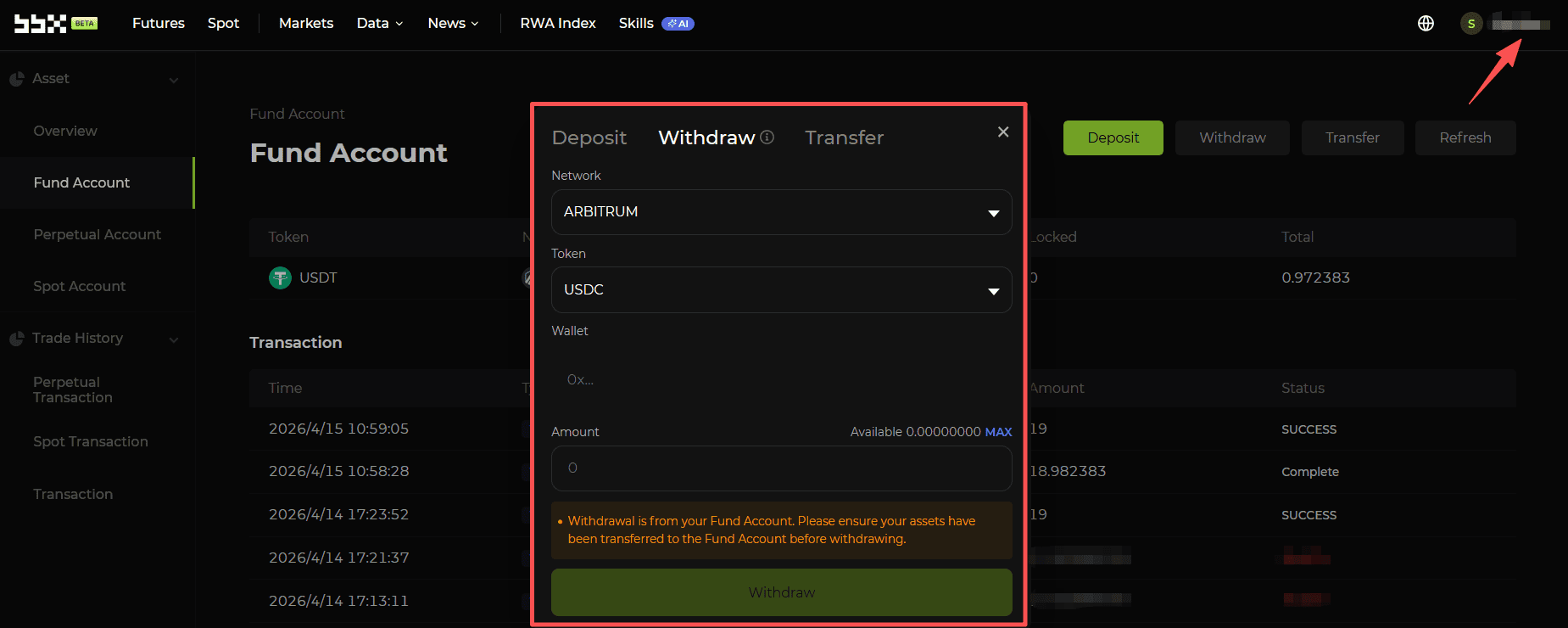
If a user’s assets are currently in the Perpetual Account or the Stock Account, the user needs to transfer the assets back to the Funding Account first, and then withdraw from the Funding Account to the target address.

The basic process is as follows:

&#x20;                                           Perpetual Account / Stock Account\
&#x20;                                                                      ↓\
&#x20;                                              Transfer back to Funding Account\
&#x20;                                                                      ↓\
&#x20;                                                 Withdraw from Funding Account\
&#x20;                                                                       ↓\
&#x20;                                                         User target address

Before initiating a withdrawal, users should confirm that:

* The assets to be withdrawn have been transferred back to the Funding Account;
* The target withdrawal address is correct;
* The assets meet the platform’s withdrawal requirements.

### Notes

* Deposited assets will first enter the Funding Account, not the Perpetual Account or the Stock Account directly.
* Before trading perpetual contracts, users need to transfer assets to the Perpetual Account.
* Before trading stocks with stablecoins, users need to transfer assets to the Stock Account.
* Before withdrawing, users need to transfer assets from the Perpetual Account or the Stock Account back to the Funding Account.
* If the withdrawal address is entered incorrectly, assets may not be recoverable. Please carefully verify the target address before confirming a withdrawal.


# Stablecoin Stock Trading

BBX Stablecoin Stock Trading aims to provide an extremely convenient, seamless channel for global users. Users can capture investment opportunities in traditional global stock markets with just one click using USDC/USDT, without the need to open a traditional account, thereby avoiding complex and lengthy deposit wait times.&#x20;

This module provides a smooth experience similar to a Centralized Exchange (CEX) and currently supports trading for nearly 200 popular US and Hong Kong stocks.

### Core Mechanism

The BBX Global Stock business perfectly integrates the rigor of traditional finance with the transparency of blockchain technology:

* **Partner Broker System Execution:** Every stock buy/sell order initiated by a user on BBX is genuinely matched and executed by BBX's partnered traditional compliant broker system on physical exchanges. Real-time market depth synchronization ensures professional and fair trade execution.
* **Stablecoin Deposits/Withdrawals, Multi-Currency Trading:** Users use stablecoins (USDT/USDC) for lightning-fast deposits and withdrawals, completely eliminating the long waits and high costs of traditional fiat cross-border currency exchange. After entering the stock account, users can flexibly allocate different currencies for multi-market trading according to their needs.
* **On-Chain Trading Certificates:** Although the underlying stocks are securely custodied within the centralized broker system, every transaction made by the user will synchronously generate a unique on-chain certificate. Asset movements are truly traceable, using blockchain transparency to safeguard your traditional asset investments.

### Trading Flow: Deposit, Transfer, and Trade

To start global stock investing on BBX, simply follow these three steps:

**1. Fund Account Deposit**&#x20;

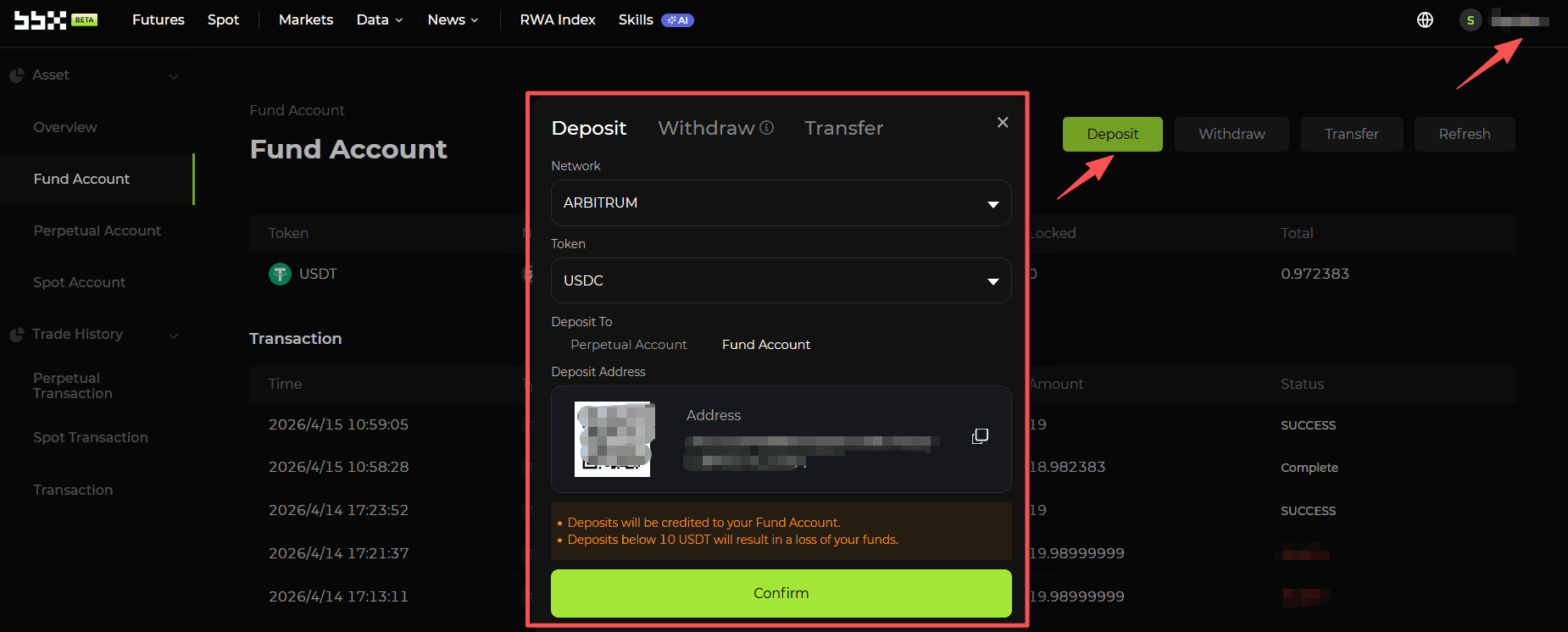
On the BBX Portfolio page, deposit your stablecoins (currently supporting USDT / USDC) via the Arbitrum chain into your \[Fund Account].

**2. Transfer to Stock Account**&#x20;

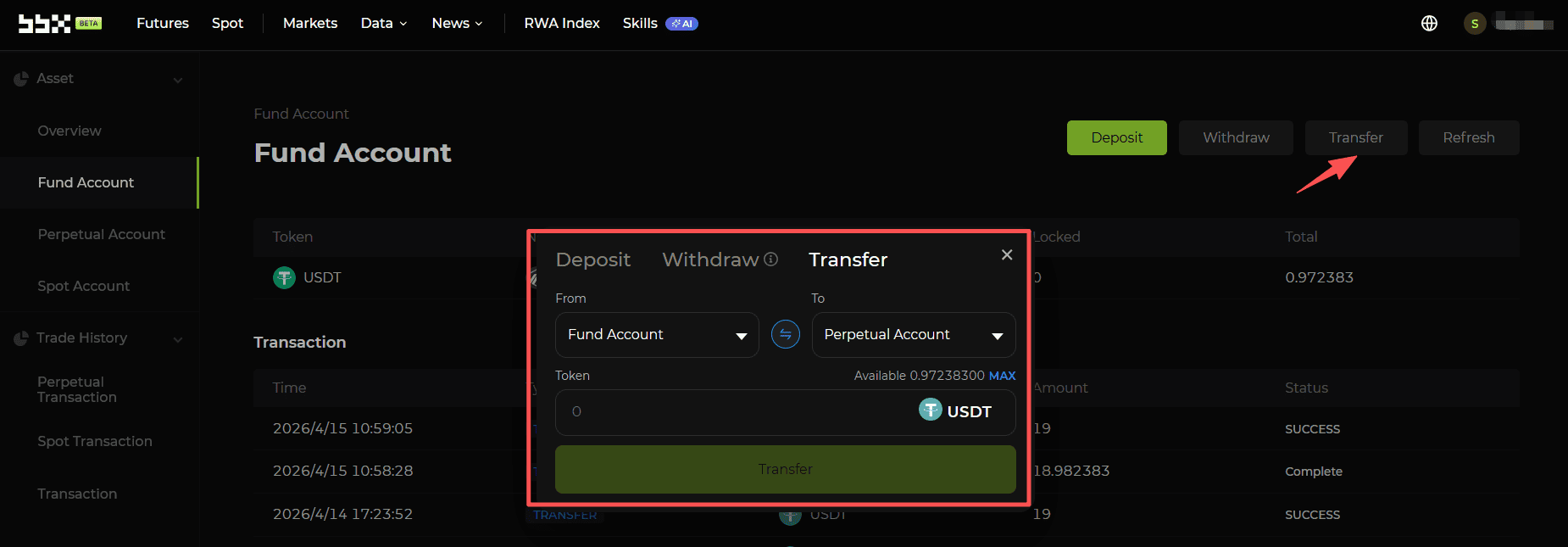
After the deposit is complete, select "Transfer" to move your stablecoins from the \[Fund Account] to the \[Stock Account] (funds enter as USD by default).

* Trading US Stocks: Directly use the USD assets in the account to trade.
* Trading HK Stocks: On the specific target asset's trading page, manually convert funds to HKD to proceed with the trade.

**3. Start Trading**&#x20;

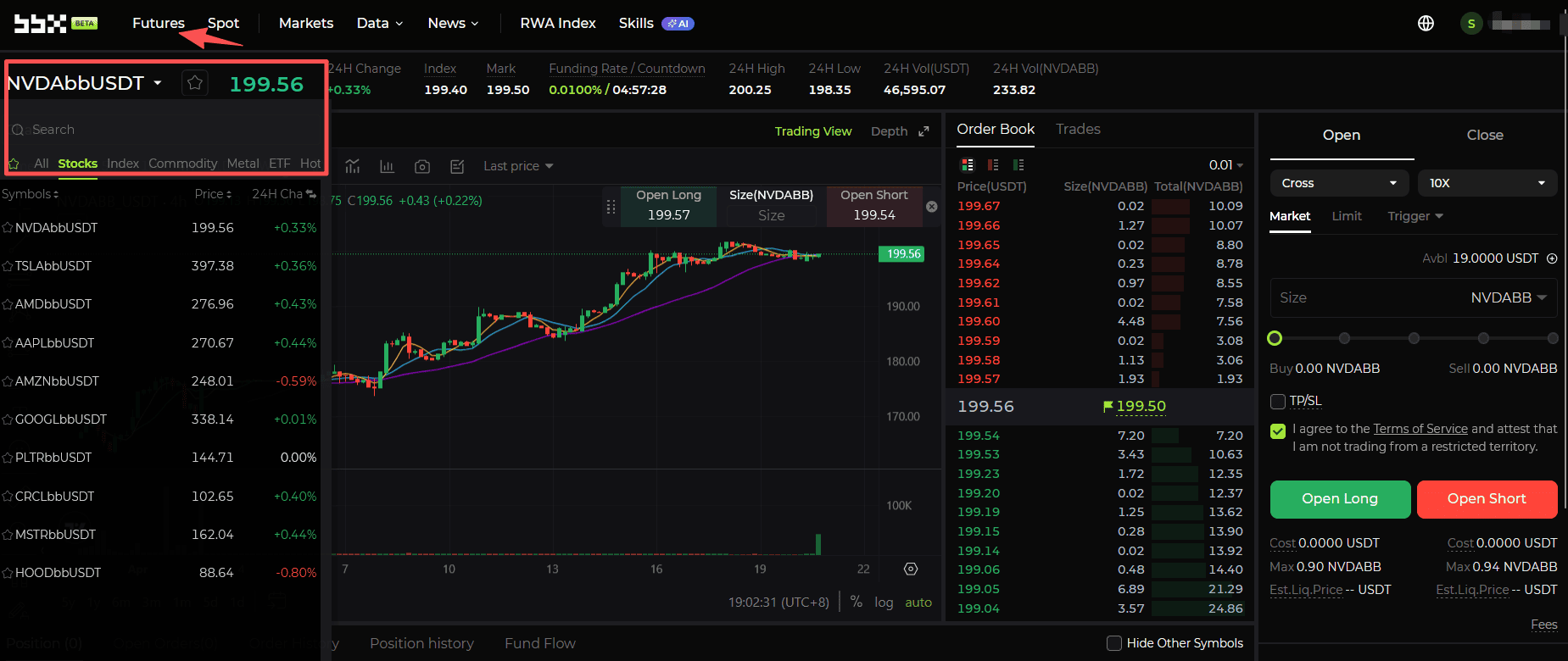
Enter the \[BBX Stock Trading Panel] and select the corresponding US or HK stock target to place an order directly.

### Order Types

Whether in the US or HK stock market, BBX supports both Limit Order and Market Order modes, helping users implement flexible strategy deployments. The platform does not currently support fractional share trading.

### Fees

BBX supports direct spot trading of US and HK stocks using stablecoins. The platform only charges a very low service fee of 0.1%, while other related fees (such as stamp duty, regulatory fees, upstream routing fees, etc.) are collected by the platform on behalf of local governments and underlying institutions like upstream brokers at their standard rates.

#### 1. US Market

<table data-header-hidden><thead><tr><th></th><th width="298.9296875"></th><th></th></tr></thead><tbody><tr><td>             <strong>Fee Type</strong> </td><td><strong>Fee Description</strong> </td><td><strong>Recipient</strong></td></tr><tr><td>Upstream Broker Platform Fee</td><td>$0.0099/share, minimum $1.99 per order</td><td>Upstream Broker</td></tr><tr><td>Trading Activity Fee</td><td>$0.000195/share (minimum $0.01, maximum $9.79 per order). Charged only upon selling.</td><td>FINRA</td></tr><tr><td>Settlement Fee</td><td>$0.003/share, minimum $0.01 per order</td><td>US settlement agency etc.</td></tr><tr><td>Consolidated Audit Trail (CAT) Fee</td><td>$0.000003/share, minimum $0.01 per order</td><td>CAT LLC</td></tr><tr><td>Service Fee</td><td>0.1% of the transaction amount, minimum $1 per order</td><td>BBX</td></tr></tbody></table>

#### 2. HK Market

| **Fee Type**                       | **Fee Description**                                                                | **Recipient**        |
| ---------------------------------- | ---------------------------------------------------------------------------------- | -------------------- |
| Upstream Broker Trading Commission | 0.03% of the transaction amount, minimum 3 HKD per order                           | Upstream Broker      |
| Upstream Broker Platform Fee       | 15 HKD per order                                                                   | Upstream Broker      |
| Stamp Duty                         | 0.1% of the transaction amount; any portion less than 1 HKD is calculated as 1 HKD | Hong Kong Government |
| Trading Fee                        | 0.00565% of the transaction amount, minimum 0.01 HKD per order                     | HKEX                 |
| SFC Transaction Levy               | 0.0027% of the transaction amount, minimum 0.01 HKD per order                      | SFC                  |
| AFRC Transaction Levy              | 0.00015% of the transaction amount, minimum 0.01 HKD per order                     | AFRC                 |
| Settlement Fee                     | 0.0042% of the transaction amount, minimum 0.01 HKD per order                      | HKEX / CCASS         |
| Service Fee                        | 0.1% of the transaction amount, minimum 8 HKD per order                            | BBX                  |

⚠️ Note: For low-priced stocks, ADRs, OTCs, special corporate actions, or securities with abnormal liquidity, BBX may adjust and charge applicable fee rates based on upstream broker policies, market conditions, or regulatory requirements. Specific fees are subject to what is displayed on the platform.

Risk Warning: The stock market involves price volatility risks. Please formulate investment strategies rationally based on your own risk tolerance.

<br>


# On-chain Perpetual Trading

For users pursuing high capital efficiency and dual-direction gaming, BBX offers a decentralized derivatives trading protocol based on a full-chain order book DEX, supporting both real-world assets and crypto perp trading.

Without needing to hold the physical securities, users can utilize stablecoin-settled derivative contracts to flexibly acquire price exposure to global core assets, seizing market volatility opportunities at any moment.&#x20;

The core BBX matching engine is built on a high-performance, Hyperliquid-like full-chain order book architecture, which, while supporting up to 20x leverage, provides deep market quotes and highly precise anti-manipulation pricing. Furthermore, the system supports 7/24 all-weather operation, using second-level instant settlement to thoroughly break the opening time constraints of traditional derivative markets, thereby maximizing capital efficiency.

We have built a diversified RWA derivatives ecosystem for you, covering U.S. stocks, global stock indices, commodities, and high-volatility ETFs. The currently supported assets are as follows:

* Mainstream U.S. Stocks: TSLA, AAPL, MSFT, AMZN, NVDA, AMD, GOOGL, PLTR, CRC, MSTR, HOOD, META, MU, TSM, INT, COIN, LITE
* Global Indices: JP225, SPX500, TW88, US30, HK50, AUS200, GER40, US2000
* Commodities: SILVER, WTIOIL, GOLD
* ETFs: QQQ, TQQQ, SQQQ, SPY, EWJ, EWY, EWT, KWEB, SOXL

In addition to stocks, BBX also supports contract trading for mainstream crypto assets, with trading mechanisms and fee rates remaining consistent.


# Overview

Perpetual trading allows users to gain price exposure to an underlying asset without actually owning it. Traders establish positions through perpetual contracts that track market prices, rather than directly exchanging tokens. BBX's perpetual trading is designed to provide ample liquidity, transparent pricing, and robust risk controls — fully integrated with the BBX ecosystem.

**What is a Perpetual Contract?**

A perpetual contract is a derivative instrument that tracks the price of an underlying asset with no expiration date. Key characteristics:

* No physical delivery of the underlying asset
* Positions can be held indefinitely as long as margin requirements are met
* Profit and Loss (PnL) is determined by price movements
* Traders can go both long and short simultaneously

**Core Components**

BBX's perpetual trading is built on several interdependent mechanisms that work together to ensure fair execution, accurate pricing, and effective risk management. Core components include: Trading Mechanism, Margin & Risk Management, and the Funding Mechanism.

**Differences from Spot Trading:**

* Spot trading involves the actual buying and selling of tokens; perpetual trading involves trading contracts that track prices.
* Perpetual trading supports leverage and short positions; spot trading does not involve liquidation risk.


# Order Types

BBX offers a comprehensive suite of order types to support active trading strategies and advanced risk management. All orders interact with the central order book and are subject to margin availability, risk limits, and liquidation rules.

**Limit Order**

* Buy Limit: Executes at the specified price or lower.
* Sell Limit: Executes at the specified price or higher.
* If not immediately matched, it enters the order book as a maker order (maker fee applies); if immediately matched, it is classified as a taker order (taker fee applies).

**Market Order**

Executes immediately at the best available price in the order book. Guarantees execution but not price; subject to market depth and volatility.

**Trigger Order**

A conditional order that activates only when a pre-set trigger price is reached. Users must specify: trigger price, order quantity, order type upon trigger (market or limit), and price reference source (Mark Price / Last Traded Price / Index Price).

**Take-Profit (TP) / Stop-Loss (SL) Orders**

* Stop-Loss: Automatically closes the position to limit losses when the market moves unfavorably.
* Take-Profit: Automatically closes the position to lock in gains when the price reaches a favorable level.
* Supports one-sided or simultaneous two-sided configuration; when both are set, triggering one automatically cancels the other.

**Time-in-Force (TIF) Options**

* GTC (Good-Till-Canceled): Remains active until fully filled or manually canceled.
* FOK (Fill-or-Kill): Must be filled in full immediately; otherwise the entire order is canceled.
* IOC (Immediate-or-Cancel): Attempts immediate execution; any unfilled portion is automatically canceled.
* Post-Only: Guarantees the order enters the book as a maker; automatically canceled if it would be matched immediately.

**Trailing Stop Order**

A dynamic risk management tool that automatically adjusts the trigger price as the market moves in the user's favor. Configuration parameters:

* Callback Rate: Maximum drawdown percentage from the best observed price, typically configurable between 0.1%–10%.
* Activation Price: The price level at which the trailing logic begins; activates immediately if not set.
* Compared to fixed stop-losses, trailing stops provide better profit protection in trending markets.


# BBX Index Price

**1. Overview**

The RWA Index is a set of real-time price indices based on multi-source data aggregation, designed to provide users with a fairer and more robust price reference for Real World Assets.

The core concept of this index is: by simultaneously collecting quote data from multiple independent trading platforms and applying a scientifically calibrated statistical algorithm to filter outliers and perform weighted aggregation, it produces a composite price indicator that better reflects actual market conditions.

**2. Data Sources**

The RWA Index is calculated based on real-time quotes from the following four independent data sources:

| Data Source         | Description                              |
| ------------------- | ---------------------------------------- |
| Ondo                | Provides on-chain RWA asset trading data |
| XStocks             | Provides real-time market quote data     |
| BBX Token           | Provides real-time market quote data     |
| Interactive Brokers | Provides real-time market quote data     |

The multi-source design ensures that the index will not be distorted by anomalous quotes from any single platform, improving data reliability and quote fairness.

**3. Index Calculation Methodology**

**3.1 Data Cleaning & Validation**

Before calculation, the system performs strict validation on each data source:

* Data Completeness: Quotes must contain valid price information; data with missing key fields will be excluded.
* Numerical Validity: Quotes must be correctly parseable as valid numbers; data with format anomalies will be filtered out.

Only data sources that pass all of the above validations will participate in the index calculation.

**3.2 Core Algorithm: Median-Constrained Average Method**

The RWA Index employs a three-step aggregation algorithm: 'Median + Deviation Constraint + Equal-Weight Average.' This method retains the reference value of each platform's quotes while effectively suppressing the impact of anomalous quotes on the index.

**Step 1: Calculate the Median**

Sort all valid data source quotes in ascending order and take the middle value as the median. If the number of sources is even, take the arithmetic average of the two middle values. The median serves as the reference baseline for the 'market consensus price.'

**Step 2: Deviation Constraint (±3%)**

Using the median as the baseline, set a reasonable fluctuation range of ±3%. Any quote exceeding this range will be automatically clipped to the boundary value. This mechanism effectively prevents an anomalous quote from any single platform (e.g., an instantaneous extreme price deviation) from having an outsized impact on the final index.

**Step 3: Equal-Weight Average**

Compute the equal-weight average of all constrained source quotes — each valid source carries the same weight in the final result. For example:

| Number of Valid Sources | Weight per Source | Formula                                 |
| ----------------------- | ----------------- | --------------------------------------- |
| 2                       | 50%               | (Price₁ + Price₂) ÷ 2                   |
| 3                       | 33.3%             | (Price₁ + Price₂ + Price₃) ÷ 3          |
| 4                       | 25%               | (Price₁ + Price₂ + Price₃ + Price₄) ÷ 4 |

**3.3 Calculation Example**

Suppose at a given moment, the four data sources provide the following closing quotes for an asset:

| Data Source         | Quote (USD) |
| ------------------- | ----------- |
| Ondo                | 100.50      |
| XStocks             | 101.20      |
| BBX Token           | 100.80      |
| Interactive Brokers | 108.00      |

Calculation Process:

* Sort: 100.50, 100.80, 101.20, 108.00
* Median = (100.80 + 101.20) ÷ 2 = 101.00
* Deviation constraint range: 101.00 × 97% = 97.97 ; 101.00 × 10³% = 104.03
* Interactive Brokers quote 108.00 exceeds the upper bound; clipped to 104.03
* Final Index = (100.50 + 101.20 + 100.80 + 104.03) ÷ 4 = 101.63

Through this algorithm, Interactive Brokers's anomalously high price of 108.00 is effectively suppressed, preventing any single platform's quote from unduly inflating the index.

**4. Degradation & Fault-Tolerance Mechanism**

The RWA Index has a robust degradation-handling capability, ensuring stable index service even when some data sources are unavailable.

**4.1 Multi-Source Degradation Strategy**

| Available Sources | Handling                                                                                     | Index Status           |
| ----------------- | -------------------------------------------------------------------------------------------- | ---------------------- |
| 4                 | Full three-step aggregation algorithm                                                        | Normal                 |
| 2–3               | Aggregation executed with available sources                                                  | Degraded               |
| 1                 | Uses the previous minute's index price; falls back to the single source if no history exists | Single-Source Degraded |
| 0                 | Index calculation paused for that minute                                                     | Paused                 |

**4.2 Fault-Tolerance Principles**

* Minute-Level Isolation: A calculation failure in a single minute does not affect index calculations at other time points.
* Data Source Independence: An anomaly in one data source does not affect the normal participation of other sources.
* Transparent Traceability: Each minute's calculation result includes the number of active sources and calculation status, enabling users to assess data quality.

**5. Index Display Metrics**

The RWA Index provides users with the following core metrics:

| Metric             | Description                                                                    |
| ------------------ | ------------------------------------------------------------------------------ |
| Current Price      | The most recent calculated index price                                         |
| Today's Open       | Opening price of the first minute candle of the current trading day            |
| Today's High / Low | Highest and lowest prices from intraday minute candles                         |
| Previous Close     | Closing price of the last minute candle from the prior trading day             |
| Price Change       | Current Price − Previous Close                                                 |
| Change %           | (Price Change ÷ Previous Close) × 100%                                         |
| Active Sources     | Number of data sources currently participating in the index calculation (0–4)  |
| Calculation Status | Current operational state: Normal / Degraded / Single-Source Degraded / Paused |

**6. Index Status Descriptions**

Users can use the index status to assess the current reliability of the data:

| Status                 | Meaning                                                                                             |
| ---------------------- | --------------------------------------------------------------------------------------------------- |
| Normal                 | All data sources are participating; index reliability is highest                                    |
| Degraded               | Some sources are missing; index is still aggregated from multiple sources; reliability remains high |
| Single-Source Degraded | Only 1 source remains; historical price smoothing is applied; reliability is lower                  |
| Paused                 | No available data sources; index updates are suspended; monitor for status changes                  |

**7. Algorithm Design Philosophy**

**7.1 Why Multi-Source Aggregation?**

A single data source may exhibit bias due to insufficient liquidity, system failures, or market microstructure differences. Multi-source aggregation significantly reduces the impact of any single platform's pricing deviation on the index, providing a more representative price reference.

**7.2 Why a ±3% Deviation Constraint?**

The ±3% deviation constraint is a reasonable threshold calibrated to the characteristics of the RWA market. It allows for normal price differences between platforms (e.g., supply and demand variations across venues) while effectively filtering out clearly anomalous quotes — striking a good balance between sensitivity and robustness.

**7.3 Why Equal-Weighting instead of Weighted?**

The RWA Index assigns equal weight to all valid data sources rather than weighting them by trading volume or other factors. This is because the RWA market is still in its early stages of development, and trading volumes across platforms may fluctuate significantly. Equal-weighting avoids introducing additional uncertainty from less stable weighting metrics.

**Disclaimer**

The RWA Index is provided as a market price reference only and does not constitute any investment advice. The accuracy of the index depends on the quality and availability of underlying data sources. Users should conduct comprehensive due diligence from multiple sources before making any trading decisions.


# Trading Mechanism

1. **System Architecture Overview**

The perpetual trading system consists of four core components: Order Matching, Price Mechanism, Position Lifecycle Management, and PnL Calculation.

2. **Order Matching**

BBX uses a centralized order matching engine with a price-time priority rule:

* Price Priority: Higher buy prices and lower sell prices receive higher priority.
* Time Priority: At the same price level, orders placed earlier are matched first.
* Trades execute at the maker price; fees are determined by whether the order is a maker or taker.
* When a limit order is partially filled, the remaining portion retains its original timestamp in the order book.
* The matching engine operates independently of the mark price and risk assessment systems, ensuring that liquidation logic is not affected by short-term liquidity conditions.

3. **Index Price**

The BBX Index Price is independently constructed by BBX. It aggregates real-time trading data from leading global spot exchanges to compute the fair market value of an underlying asset, serving as the core benchmark for mark price calculations. For details, see '3.2.3 BBX Index Price.'

4. **Mark Price**

The mark price is the fair value of a perpetual contract, used for all risk-related calculations (unrealized PnL, margin adequacy checks, forced liquidation, ADL) — not the last traded price. It is designed to track the underlying spot market while resisting short-term volatility, low-liquidity trades, and price manipulation.

Formula: Mark Price = Median (Price 1, Price 2, Contract Price)

**Price 1**

Price 1 represents an index-based forecast that accounts for the time remaining until the next funding event.

Price 1 = Index Price × (1 + Funding Rate × (Time to Next Funding Settlement ÷ Funding Interval))

This component reflects the expected convergence of the perpetual contract price toward the spot price over the funding period.

**Price 2**

Price 2 incorporates the latest basis between the perpetual contract and the index price.

Price 2 = Index Price + Moving Average Basis × (1 + Funding Rate)

**Contract Price**

The contract price refers to the most recent transaction price of the perpetual contract in the order book.

**Moving Average**

The moving average measures the average deviation between the perpetual market and the underlying index.

Calculation: Moving Average Basis = Moving average of ((Best Bid + Best Ask) ÷ 2 − Index Price)

The basis is sampled using a rolling 30-minute window to smooth out short-term fluctuations.

**Median Selection Mechanism**

After calculating Price 1, Price 2, and the Contract Price, the system selects the median value as the final mark price. This median-based approach ensures that extreme outliers — whether from sudden trades or anomalous reference prices — do not have a disproportionate impact on liquidation or margin outcomes.

**Deviation Protection**

If the deviation between the index price and the calculated mark price exceeds a predefined threshold (e.g., greater than 1%), additional safeguards are applied. In this case:

* The mark price may be directly anchored to Price 2.
* This prevents excessive divergence under anomalous market conditions.

**Fallback Protection Mechanism**

In rare circumstances where a stable and reliable index price is unavailable (e.g., during exchange outages or severe data distortion), BBX will activate the Last Traded Price protection mechanism. Under this mechanism:

* The mark price temporarily references the most recent contract transaction price.
* A bounded adjustment range is applied to prevent abrupt changes.
* Risk calculations can continue without interruption.

Once reliable index data is restored, the system automatically resumes standard mark price calculation.

**Mark Price and Unrealized PnL**

A trader may observe positive or negative unrealized PnL immediately after order execution. This is because the actual execution price may differ slightly from the mark price. This is normal and does not represent an immediate loss. Traders should focus on the liquidation price and margin ratio rather than short-term unrealized PnL fluctuations.

5. **Position Lifecycle**

In perpetual trading, a position represents a trader's directional exposure to an underlying asset. The position lifecycle describes how a position is created, adjusted, and ultimately closed over time.

**Position Creation**

A position is formed when a trader executes a trade in the perpetual contract market.

* Buying a perpetual contract establishes a long position.
* Selling a perpetual contract establishes a short position.

Once the trade is executed, the following are established: position direction (long or short), position size, and entry price. The position takes effect immediately upon execution.

**Position Adjustment**

After a position is opened, its size and average entry price may change as a result of subsequent trades. Position adjustments include:

* Increasing position size by executing trades in the same direction as the existing position.
* Reducing position size by executing a reverse trade to partially close the position.
* Reversing the position direction by fully closing the existing position and opening a new one in the opposite direction.

Each adjustment updates the position size, average entry price, and realized PnL accordingly.

**Unrealized PnL**

As market prices change, an open position continuously generates unrealized PnL.

* Unrealized PnL reflects the difference between the position's entry price and the current mark price.
* Unrealized PnL fluctuates with market movements.
* Unrealized PnL is only settled after the position is reduced or closed.

Unrealized PnL plays a crucial role in margin assessment and liquidation risk evaluation.

**Realized PnL**

Realized PnL is generated when a position is partially or fully closed. Realized PnL arises when:

* A portion of the position is closed through a reverse trade.
* The trader voluntarily closes the position.
* The position is closed through liquidation.

Once realized, the PnL is settled into the trader's account balance and no longer fluctuates with market prices.

**Position Closure**

A position can be closed in one of the following ways:

* Voluntary Closure: The trader submits a trade to fully offset the position.
* Forced Closure (Liquidation): The position is automatically closed when margin no longer meets requirements.

In both cases, the position size is reduced to zero, and all remaining unrealized PnL is converted to realized PnL.

**Relationship with Risk Management**

Throughout the position lifecycle, the platform's risk management system continuously monitors positions.

* Position size affects leverage ratio and risk exposure.
* Unrealized PnL affects available margin.
* Market price movements affect liquidation risk.

The position lifecycle in perpetual trading describes the entire process from opening, through adjustment, to final closure. BBX ensures accurate accounting and consistent risk assessment throughout the entire perpetual position lifecycle by tracking position status, entry price, and PnL in real time.

6. **PnL Calculation**

Profit and Loss (PnL) measures the financial result of a user's trading activity. PnL is divided into unrealized PnL and realized PnL, each playing different roles in position tracking and risk management.

* Unrealized PnL: Continuously updated based on average entry price, position size, direction, and current mark price. Used for margin ratio calculations and liquidation checks.
* Realized PnL: Generated through partial or full position closure or funding payments, and immediately settled to the account balance.
* Partial Closure: Only the PnL for the closed quantity is realized; the average entry price of the remaining position is unchanged.

Average Entry Price Formula: Average Entry Price = Total Position Value ÷ Total Contract Quantity

PnL values directly impact margin utilization, liquidation prices, and risk exposure. Traders should closely monitor unrealized PnL, margin ratio, and liquidation thresholds — especially during periods of high market volatility.


# Margin

Maintenance margin is the minimum margin required to keep a position open. If unrealized losses cause the position margin to fall below this threshold, forced liquidation is triggered. BBX adopts a tiered risk framework to set maintenance margin requirements. As the notional value of a position increases, the required maintenance margin rate also increases.

Formula: Maintenance Margin (MM) = Position Value × Maintenance Margin Rate

* Position Value = Number of Contracts × Mark Price
* Initial Margin (IM) = Position Value ÷ Leverage

Traders should closely monitor the margin ratio, liquidation price, and the relationship between position size and risk tier. Maintaining sufficient margin reduces liquidation risk, especially during periods of high market volatility.


# Funding Rate

The funding mechanism ensures that perpetual contract prices remain pegged to spot market prices. Funding is transferred directly between longs and shorts — BBX does not charge any funding fee.

**Rate Direction:**

* Positive Funding Rate (Perpetual Price > Spot Price): Longs pay shorts.
* Negative Funding Rate (Perpetual Price < Spot Price): Shorts pay longs.

**Settlement Times:**

* Industry-standard: settled every 4 hour.
* Only applies to positions held at the settlement timestamp.
* Positions closed before settlement do not participate.

**Impact on Margin:**

Funding fees are deducted from the available account balance first; if the balance is insufficient, they are deducted from the position margin, causing the liquidation price to move closer to the mark price and increasing liquidation risk.

**Variable Intervals During Volatility:**

During periods of extreme market volatility, the funding settlement interval may be adjusted to accelerate price convergence. Adjustments are made in a transparent manner.


# Liquidation

Liquidation is a risk control mechanism that forcibly closes positions when a trader's margin is insufficient to cover potential losses. BBX implements a structured forced liquidation process to protect both individual traders and the overall market stability.

**Liquidation**

Liquidation is triggered when a position's available margin falls to or below the maintenance margin requirement. At this point, the position can no longer safely absorb further losses.

Upon triggering forced liquidation:

* The system will forcibly close the position.
* The maintenance margin is reduced to zero.
* All open orders for the affected contract will be canceled to free up margin.

**Mark Price**

BBX uses the mark price — not the last traded price — to assess liquidation conditions, preventing unnecessary forced liquidation from brief price anomalies, low-liquidity trades, or short-term market manipulation. Liquidation is only triggered when the mark price reaches the liquidation price.

**Partial Liquidation**

Rather than closing the entire position at once, BBX uses partial liquidation wherever possible. Partial liquidation:

* Gradually reduces position size.
* Reduces maintenance margin requirements.
* Minimizes market impact.
* Increases the probability of position survival.

**Open Order Handling**

When liquidation is triggered:

* All pending open orders for the same contract will be canceled.
* The margin reserved for those orders will be released.
* Open orders for other contracts are unaffected.

**Margin Modes**

BBX supports both Isolated Margin Mode and Cross Margin Mode.

**1) Isolated Margin Mode**

In isolated margin mode, each position has an independent margin allocation. Losses are limited to the margin allocated to that position and do not affect other balances in the account.

Liquidation Price Formulas (Isolated):

* Long Position: (Average Entry Price × Quantity × Contract Value + Maintenance Margin − Initial Margin) ÷ (Quantity × Contract Value) (rounded up)
* Short Position: (Average Entry Price × Quantity × Contract Value − Maintenance Margin + Initial Margin) ÷ (Quantity × Contract Value) (rounded down)

**2) Cross Margin Mode**

In cross margin mode, all available account balances serve as shared margin for all positions. The initial margin is calculated for a specific position, while all remaining available balances collectively support all open positions.

Liquidation occurs only when:

* Available margin falls to zero, AND
* Maintenance margin requirements can no longer be met.

**Liquidation Outcomes:**

* If losses exceed the margin, all margin is lost.
* If losses are less than the margin, the remaining margin is returned.
* Liquidation execution is irreversible and may be filled at unfavorable prices during periods of extreme market volatility.

⚠️ **Perpetual contracts carry extremely high risk.** Leverage amplifies losses, and liquidation is irreversible. Only use funds you can afford to lose entirely.


# Insurance Fund

The insurance fund is a reserve mechanism designed to protect BBX markets from losses that exceed an individual trader's margin in a liquidation event.

**Purpose of the Insurance Fund**

* Absorbs liquidation shortfalls.
* Protects profitable traders from being liable for other traders' losses.
* Reduces the probability of triggering Auto-Deleveraging (ADL).

**How the Insurance Fund Works**

When a position is liquidated, the system attempts to close it at a price no worse than the bankruptcy price.

* If the actual fill price is better than the bankruptcy price, the remaining margin is contributed to the insurance fund.
* If the actual fill price is worse than the bankruptcy price, the insurance fund covers the shortfall.

**Bankruptcy Price**

The bankruptcy price is the price level at which a trader's entire initial margin is fully depleted.

When the price reaches the bankruptcy price:

* The trader's margin balance reaches zero.
* The position can no longer sustain further losses.
* Any further losses must be covered by the insurance fund or the Auto-Deleveraging (ADL) mechanism.

**Insurance Fund Depletion**

Under extreme market conditions, multiple large liquidations may occur simultaneously.

If losses exceed the available balance of the insurance fund:

* The fund balance may fall below a predefined safety threshold.
* The system will escalate to the Auto-Deleveraging (ADL) mechanism to maintain system solvency.


# Auto-Deleveraging (ADL)

Auto-Deleveraging (ADL) is a last-resort risk management mechanism that activates only when liquidation losses cannot be fully absorbed by the trader's margin and the insurance fund.

**ADL Trigger Conditions**

ADL is triggered when:

* The actual liquidation fill price is worse than the bankruptcy price, AND
* The insurance fund's rate of depletion exceeds a predefined safety threshold.

ADL is not part of normal trading operations and only occurs under extreme market conditions.

**How ADL Works**

When ADL is activated:

* The positions of the counterparties to the liquidated position are forcibly reduced.
* Reduction starts with traders ranked highest in ADL priority.
* Positions may be partially or fully reduced.

Affected traders may immediately re-enter the market after an ADL event.

**ADL Priority Ranking**

ADL does not affect all traders equally. Positions are ranked based on profitability and leverage ratio.

ADL Ranking Logic:

* Profitable Positions: ADL Rank = Profit Percentage × Effective Leverage
* Loss-Making Positions: ADL Rank = Profit Percentage ÷ Effective Leverage

Variable Definitions:

* Effective Leverage = |Mark Value ÷ (Mark Value − Bankruptcy Value)|
* Profit Percentage = (Mark Value − Average Entry Value) ÷ |Average Entry Value|
* Mark Value = Position value calculated at the mark price
* Bankruptcy Value = Position value calculated at the bankruptcy price
* Average Entry Value = Position value calculated at the average entry price

**ADL Risk Indicator**

The BBX trading interface displays an ADL risk indicator for each position:

* The indicator reflects the trader's relative ADL ranking.
* Rankings are displayed in 20% increments.
* More lit segments indicate higher ADL risk.
* Positions with most or all segments lit carry a higher probability of being reduced in an ADL event.

**Reducing ADL Risk**

Traders can reduce their ADL risk exposure by:

* Using lower leverage.
* Taking profits regularly.
* Maintaining sufficient margin.
* Continuously monitoring margin ratio and liquidation price.

**ADL vs. Forced Liquidation**

Forced liquidation applies to loss-making positions that can no longer meet maintenance margin requirements. ADL applies only to profitable, high-leverage positions, and activates only after all other risk buffers have been exhausted. Both mechanisms work together to maintain the overall stability of the system.


# Fees

To reward active participation, BBX employs a VIP tiered fee system that offers progressively lower trading fees as volume increases.

| Tier | 14D Volume in Spot & Perps (USD) | Perps Taker Fee | Perps Maker Fee |
| ---- | -------------------------------- | --------------- | --------------- |
| VIP0 | < $500,000                       | 0.055%          | 0.015%          |
| VIP1 | ≥ $500,000                       | 0.050%          | 0.012%          |
| VIP2 | ≥ $2,000,000                     | 0.048%          | 0.01%           |
| VIP3 | ≥ $10,000,000                    | 0.045%          | 0.008%          |
| VIP4 | ≥ $50,000,000                    | 0.043%          | 0.006%          |
| VIP5 | ≥ $100,000,000                   | 0.040%          | 0.004%          |
| VIP6 | ≥ $200,000,000                   | 0.038%          | 0.000%          |
| VIP7 | ≥ $500,000,000                   | 0.036%          | 0.000%          |
| VIP8 | ≥ $1,000,000,000                 | 0.033%          | 0.000%          |


# Transparency

Transparency Dashboard

The BBX Transparency Dashboard provides a real-time, data-driven view into the activity of the BBX ecosystem. It is designed to enhance transparency, strengthen user confidence, and ensure that all trading activity is observable, verifiable, and fair.

***

#### Overview <a href="#overview" id="overview"></a>

The BBX ecosystem operates as a shared liquidity network, enabling multiple trading venues and frontends to access the same underlying infrastructure. To ensure transparency across this ecosystem, BBX provides a public dashboard that aggregates and displays key user, market, and transaction data in real time.

The Transparency Dashboard allows users to independently observe:

* Overall ecosystem activity
* Market-level trading dynamics
* Individual user trading and position data
* Real-time transaction execution

By making these data points publicly accessible, BBX reinforces trust in the fairness, integrity, and neutrality of the trading environment.

***

#### Stats View <a href="#stats-view" id="stats-view"></a>

The **Stats** panel presents a high-level overview of the BBX ecosystem’s activity and market conditions.

Key metrics available in this view include:

* Total user activity across the BBX ecosystem
* Aggregated trading volume
* Market-level statistics for Spot and Perpetual products
* Real-time and historical funding rate data
* Other system-wide performance indicators

This view is intended to give users a macro-level understanding of market participation and overall ecosystem health.

***

#### User View <a href="#user-view" id="user-view"></a>

The **User View** focuses on trader-level data and participation within the BBX ecosystem.

In this section, users can:

* View **Top Perpetual Traders** ranked by performance or activity
* Inspect trading activity associated with a specific wallet address
* Review a user’s:
  * Historical trades
  * Open and closed positions
  * Position sizes and exposure

All data displayed reflects activity aggregated across the BBX ecosystem, providing a comprehensive and unified view of user participation regardless of the frontend used to execute trades.

***

#### Transaction View <a href="#transaction-view" id="transaction-view"></a>

The **Transaction View** provides a real-time feed of individual trades as they occur across the BBX ecosystem.

This view allows users to:

* Observe live trade execution
* Monitor market activity as it happens
* Verify that trades are executed transparently and consistently
* Gain insight into liquidity, order flow, and market dynamics

By exposing transaction-level data in real time, BBX enables users to independently validate trading activity and execution fairness.

***

#### Transparency and Fairness <a href="#transparency-and-fairness" id="transparency-and-fairness"></a>

The Transparency Dashboard is a core component of BBX’s commitment to openness and accountability.

By making ecosystem-wide data publicly accessible, BBX aims to:

* Increase confidence in fair and unbiased trade execution
* Reduce information asymmetry between participants
* Allow independent verification of market activity
* Strengthen trust in the integrity of the protocol and its liquidity aggregation model

All users, regardless of trading volume or role within the ecosystem, have equal access to the same data and insights.

***

#### Summary <a href="#summary" id="summary"></a>

The BBX Transparency Dashboard serves as a public window into the real-time operation of the BBX ecosystem. By exposing user activity, market metrics, and transaction-level data, the dashboard reinforces BBX’s principles of fairness, openness, and trust, empowering users to trade with greater confidence and clarity.


# On-chain Spot Trading

For users seeking transparent asset circulation and authentic on-chain ownership, BBX offers a high-performance decentralized spot trading protocol based on a full-chain order book DEX architecture.&#x20;

Breaking down the barriers between traditional finance and Web3, this protocol supports not only the instant exchange of mainstream crypto-native assets but also seamlessly integrates spot trading pools for tokenized real-world assets (RWA).&#x20;

Powered by an underlying decentralized matching engine, the BBX spot module delivers deep liquidity and lightning-fast trading experiences comparable to centralized exchanges (CEXs), while ensuring zero counterparty risk and the security of 100% on-chain settlement. This empowers users to efficiently build and manage a diversified, cross-border spot investment portfolio with ultra-low friction costs, all while retaining absolute control over their assets.


# Overview

BBX On-chain Spot trading refers to the direct exchange of assets between buyers and sellers at the current market price. Once a trade is executed, the transaction is settled immediately, and each party receives the corresponding asset.

In spot markets, traders exchange \*\*real, underlying tokens\*\*, and ownership of the asset is transferred upon settlement.

#### How On-chain Spot Trading Works

In an on-chain spot trading pair such as ETH/USDT:

* Buying ETH means paying USDT at the current spot price and receiving ETH
* Selling ETH means delivering ETH and receiving the equivalent amount of USDT

After the trade is completed,

* the buyer holds ETH in their account
* the seller holds USDT in their account

There is no leverage, expiration, or contract-based settlement involved in on-chain spot trading.

#### Key Characteristics

* Immediate settlement
* Direct ownership of the underlying asset
* No leverage or liquidation mechanism
* Profit and loss depend solely on price movement of the asset

On-chain spot trading is commonly used by traders who wish to \*\*own assets outright\*\* or execute simple buy-and-sell strategies without additional risk layers.

#### On-chain Spot Trading vs Perpetual Trading

On-chain spot trading and perpetual trading differ fundamentally in how positions are structured and settled.

**Asset Ownership**

For On-chain Spot Trading,

* Traders buy and sell the actual underlying tokens
* For example, buying ETH means holding ETH in the account
* The trader benefits if the asset price rises and incurs losses if the price falls

For On-chain Perpetual Trading,

* Traders do \*\*not\*\* own the underlying asset
* Instead, they trade perpetual contracts that track the price of the asset
* Positions represent exposure to price movements rather than token ownership

**Trading Direction**

For On-chain Spot Trading,&#x20;

* Traders can only profit from price appreciation
* Selling requires holding the asset beforehand

For On-chain Perpetual Trading,

* Traders can go \*\*long\*\* when expecting prices to rise
* Traders can go \*\*short\*\* when expecting prices to fall
* Both directions are available without holding the actual token

**Risk Profile**

For On-chain Spot Trading,&#x20;

* No liquidation risk
* Losses are limited to the initial investment
* Positions can be held indefinitely

For On-chain Perpetual Trading,

* Positions may be subject to liquidation
* Leverage amplifies both gains and losses
* Funding payments may apply depending on market conditions

#### Summary

On-chain spot trading enables straightforward asset exchange with immediate settlement and full ownership of the underlying tokens. It is well suited for users seeking simple exposure to asset price movements without leverage or contract-based risk.

In contrast, perpetual trading offers flexible directional exposure and leverage but does not involve ownership of the underlying asset and introduces additional risk factors.

Understanding these differences allows traders to choose the trading method that best aligns with their strategy and risk tolerance.


# Order Types

BBX On-chain Spot Trading supports two primary order types: Limit Orders and Market Orders. These order types allow users to execute trades based on their preferred pricing strategy and execution urgency.

In on-chain spot markets, users can place:

* **Limit Orders**
* **Market Orders**

Each order type serves a different trading purpose and offers distinct advantages depending on market conditions.

#### **Limit Orders**

A limit order allows a trader to specify the exact price at which they are willing to buy or sell an asset.

* A buy limit order will execute at the specified price or lower
* A sell limit order will execute at the specified price or higher

Limit orders are added to the order book and will only be executed when the market reaches the specified price.

**Use Cases for Limit Orders**

Limit orders are commonly used to:

* Enter the market at a specific desired price
* Reduce trading costs by acting as a maker
* Gradually accumulate or distribute assets
* Partially or fully execute trades as liquidity becomes available

Because execution depends on market conditions, limit orders are not guaranteed to be filled.

#### Market Orders

A market order is an instruction to immediately buy or sell a specified quantity of an asset at the best available prices in the order book.

Market orders prioritize execution speed over price certainty.

**Key Characteristics of Market Orders**

* Immediate execution, provided sufficient liquidity exists
* Execution price is determined by current market depth
* Final execution price may differ from the last traded price due to slippage

Market orders are particularly useful when rapid execution is required.

**Common Use Cases**

Market orders are often used when:

* Entering or exiting a position quickly
* Trading in fast-moving or highly volatile markets
* Ensuring execution is more important than obtaining a specific price

#### Execution Considerations

When placing any order in the spot market, traders should consider:

* Available liquidity in the order book
* Potential price slippage for larger market orders
* Market volatility at the time of execution

Understanding how different order types behave under varying market conditions can help traders execute more effectively.

#### Summary

Limit orders offer price control and potential cost savings but may not be filled immediately. Market orders ensure rapid execution but do not guarantee a specific price.

By selecting the appropriate order type, traders can align their execution strategy with their risk tolerance and market outlook.

<br>


# Fees

On-chain spot trading on BBX follows a transparent maker-taker fee model. Trading fees are charged at the protocol level and vary based on the user’s VIP tier.

#### Fee Model Overview

BBX applies a maker-taker fee structure for on-chain spot trading:

* Maker fees apply when an order adds liquidity to the order book
* Taker fees apply when an order removes liquidity from the order book

Fee rates are determined by the user’s [BBX VIP tier](/fees-and-vip/bbx-dex-fees-and-vip-system), which is calculated based on rolling 14-day trading volume across the BBX DEX.

#### &#x20;Maker Fees

A maker order is an order that adds liquidity to the order book.

In on-chain spot trading, maker fees typically apply when:

* A limit order is placed at a price that does not immediately match an existing order
* The order remains in the order book until another trader executes against it

Maker orders contribute to market liquidity and may benefit from lower fees under higher VIP tiers.

#### Taker Fees

A taker order is an order that removes liquidity from the order book.

In on-chain spot trading, taker fees typically apply when:

* A market order is submitted
* A limit order is placed that immediately matches an existing order in the order book

Taker orders prioritize immediate execution and are charged according to the taker fee rate associated with the user’s VIP tier.

#### VIP-Based Fee Schedule

On-chain spot trading fees on BBX are determined by the [BBX VIP System](/fees-and-vip/bbx-dex-fees-and-vip-system).

* Fee rates decrease as users qualify for higher VIP tiers
* VIP tiers are evaluated based on rolling 14-day trading volume
* Fee rate changes take effect immediately upon tier qualification

For detailed VIP tier thresholds and spot fee rates, please refer to [BBX DEX Fees & VIP System](/fees-and-vip/bbx-dex-fees-and-vip-system).

#### &#x20;Fee Applicability and Scope

* On-chain spot trading fees are charged only on executed trades
* Fees are deducted from the received asset at settlement
* No fees are charged for deposits or internal transfers between accounts

#### Summary

On-chain spot trading fees on BBX are governed by a transparent, VIP-based maker-taker model. With no additional frontend or channel fees applied, users trading on BBX benefit from clear, predictable costs that scale favorably with trading activity.

Understanding the fee structure allows traders to optimize execution strategies and manage trading costs more effectively.


# Global Asset Tokenization

To provide on-chain users with greater trading freedom, BBX leverages a rigorous compliance framework to successfully bring premium global assets onto the blockchain.&#x20;

By completely dismantling the geographical barriers and market hours of traditional finance, BBX enables you to seamlessly allocate a diverse range of high-quality targets—including mainstream U.S. stocks and Pre-IPO assets—all in one place.


# Security & Compliance

User asset security and compliance are the foundational pillars of the BBX platform. As a leading technical service protocol provider, BBX collaborates with top-tier licensed financial institutions worldwide through independent custody mechanisms. We ensure the absolute authenticity and security of underlying assets while delivering a seamless, high-performance RWA trading experience.

#### Multi-Party Compliance Architecture

BBX integrates specialist partners across multiple domains, forming an ecosystem with clear accountability and mutual checks and balances:

* **BBX Protocol:** Technical service provider, delivering the trading software interface and smart contract protocol. BBX never touches, holds, or controls user funds.
* **Licensed and Compliant Broker:** Asset custodian and broker, independently responsible for purchasing and segregated-custody of real equities.
* **Licensed Issuer:** Tokenization issuer, responsible for tokenizing the real equities held in the licensed and compliant broker's custody on a 1:1 basis.

<figure><img src="/files/Er7MffAx6cJh8ySThzt2" alt=""><figcaption></figcaption></figure>

#### Core Security Guarantee: Bankruptcy Isolation

Users' real equity assets are held in a dedicated 'Client Omnibus Segregated Account' established by the licensed and compliant broker, completely separated from the corporate assets of both BBX and the licensed and compliant broker. Even under any extreme circumstances — including the bankruptcy of BBX or the licensed and compliant broker — users' ownership of their assets is protected by law.

#### Global User Access Policy

The BBX Protocol strictly complies with the laws and regulations of each jurisdiction:

* **Restricted Jurisdictions:** Services are not available to users in the United States or any internationally sanctioned regions (e.g., North Korea, Iran, Syria, Cuba).
* **Technical Measures:** IP Geofencing and OFAC sanctions list screening.
* **Mandatory KYC:** Triggered at required stages, such as equity redemption.

#### BBX Legal Status

BBX is not a traditional brokerage or centralized exchange — it is a non-custodial, decentralized technology protocol. BBX provides only the trading software interface and smart contract protocol, functioning essentially as a Software-as-a-Service (SaaS) provider.


# Dual-token Model

To balance compliance with the efficiency of on-chain trading, BBX has pioneered a 'Dual-Token Model' — the t-token and the bb-token. Using NVDA as an example:

<figure><img src="/files/01Ld8ga5USfpPs8DCej6" alt=""><figcaption></figcaption></figure>

**NVDAt — Security-based Token**

* **Nature:** Compliant ownership anchor.
* **Function:** NVDAt is the legal certificate proving a user's ownership of real equities. It is issued by the licensed issuer, pegged 1:1 to real equities held in the licensed and compliant broker's segregated account. It functions as a 'digital title deed,' ensuring the legal standing of ownership.
* **Characteristics:** Carries strict compliance information. NVDAt itself does not directly participate in high-frequency trading, in order to preserve its legal standing.

**NVDAbb — Liquidity Utility Token**

* **Nature:** Liquidity utility certificate.
* **Function:** When NVDAt is deposited into the smart contract, the contract mints NVDAbb at a 1:1 ratio. NVDAbb is designed for high-frequency trading and DeFi integration, enhancing the interoperability and liquidity of securities-type assets within the on-chain ecosystem.
* **Characteristics:** NVDAbb is subject to invisible compliance checks by BBX (IP geolocation, OFAC list, etc.), ensuring that all transactions remain within the compliance framework without disrupting the user experience.

#### Contract Addresses

BBX has completed the compliant tokenization minting of the following assets and will successively open spot trading for them on the on-chain order book DEX. Due to the high-performance full-chain architecture, users can break through the closure limitations of traditional markets to achieve 7×24 all-weather spot asset trading.

| Ticker | t Token | Contract Address (t)                       | bb Token | Contract Address (bb)                      | Network  |
| ------ | ------- | ------------------------------------------ | -------- | ------------------------------------------ | -------- |
| AAPL   | AAPLt   | 0xfbabcd2f510bbbf6fbf1c54a2b4b3fbfd7a7f09e | AAPLbb   | 0xe5e6dbb9259d8459fa4b9548df19ba9ea39a3186 | Arbitrum |
| AMZN   | AMZNt   | 0xe5f075e5d031a9360792d1c57bb14ab37d149251 | AMZNbb   | 0xa115b0256c6dce0a9b4a007b49100b65f7bc16f3 | Arbitrum |
| GOOGL  | GOOGLt  | 0x0fe7b1939ef64ee7413c8334edb02f93974237f3 | GOOGLbb  | 0xa40c38c30da848754f2308a2fd37573baf84ca3c | Arbitrum |
| PLTR   | PLTRt   | 0xfbd7fd27e1a7117f6331595167d89dd9356e3813 | PLTRbb   | 0x9ac96785d3c325f91b9ff37426f183d34b1e82a5 | Arbitrum |
| CRCL   | CRCLt   | 0x91f065dffab8fa5829368b1c6c8fc86a13b96226 | CRCLbb   | 0x653f56245705aef339768fade62c95da03165ced | Arbitrum |
| MSTR   | MSTRt   | 0x7526047633fef858dfb740b7fc79a591bb7fe8cf | MSTRbb   | 0xf006a779d429798a1cba0d7544542713a7473342 | Arbitrum |
| HOOD   | HOODt   | 0xc4513eb06e86a262be8dbeb152c72c61520c5828 | HOODbb   | 0x8a5a98053562dbefae511b827d400f539b6420a2 | Arbitrum |
| TSLA   | TSLAt   | 0x3bFfBF70015733A3A36A118E328bD720c2500F2C | TSLAbb   | 0xb5c810224a46894650da0db93b61b9beb4b33d6c | Arbitrum |
| AMD    | AMDt    | 0x354637c9d2FB6701D7f03007d100fe29D82665Fa | AMDbb    | 0x1c2b9e6c8b59292ad3e98b9f0b57a893dc42c743 | Arbitrum |
| NVDA   | NVDAt   | 0x14a145639f8eC2C30a582Abb68569DbFfE377c28 | NVDAbb   | 0x879292708da2b467cbb6590e207f56bb90d946c0 | Arbitrum |

#### Audit Reports

[https://d.cobo.com/public/documents/blocksec\_CoboTokenization\_v1.0-signed.pdf](https://www.google.com/url?q=https://d.cobo.com/public/documents/blocksec_CoboTokenization_v1.0-signed.pdf\&sa=D\&source=editors\&ust=1774614901592838\&usg=AOvVaw13Es9mY6H_Zy7UWIN3bTVC)

[https://github.com/CoboGlobal/cobo-tokenization/blob/master/docs/blocksec\_cobotokenization(CoboERC20Wrapper)\_v1.0-signed.pdf](https://www.google.com/url?q=https://github.com/CoboGlobal/cobo-tokenization/blob/master/docs/blocksec_cobotokenization\(CoboERC20Wrapper\)_v1.0-signed.pdf\&sa=D\&source=editors\&ust=1774614901593427\&usg=AOvVaw0f27S2PhKyO4HMBrif-_re)

#### Core Identity

Total Circulating NVDAbb = Total Locked NVDAt = Total Custodied Real Shares

This identity is enforced by smart contracts and can be publicly verified on-chain in real time, ensuring that every unit of on-chain proof is backed by sufficient real assets.


# BBX Vault (Coming Soon)

BBX Vault is a share-based, decentralized asset management and liquidity yield tool. By integrating with the underlying asset management infrastructure, users can deposit assets (such as USDT) into the vaults to obtain vault shares, proportionally sharing the yields or bearing the risks based on the fluctuations in the vault's net asset value.

#### Core Operating Mechanisms

BBX Vault adopts a fund-style share allocation and dynamic settlement model featuring transparent clearing and fully auditable on-chain data:

* Asset Subscription: When a user deposits a designated underlying asset (e.g., USDT), the system automatically calculates and issues the corresponding vault shares (Shares) based on the vault's current Net Asset Value Per Share (NAVPS). Upon successful subscription, the assets immediately enter the vault's capital pool and participate in the preset strategies.
* Yield Accumulation & NAV Fluctuations: All market-making revenues, arbitrage profits, or trading gains/losses generated after the vault capital goes live are instantly credited to the vault's total assets. This directly drives the rise or fall of the Net Asset Value Per Share (NAVPS). The user's actual yield depends entirely on the difference in NAVPS between subscription and redemption.
* Redemption & Fee Impact: Users can freely redeem their held vault shares. The final credited amount received upon redemption is dynamically affected by multiple cost factors, including the vault type, current profit performance, and market liquidity:
  * Operator Fee: The platform itself does not charge any redemption fees. For the "Protocol Vault" managed by the platform, no operator fee is currently charged. For the "User Vault" managed by traders, the operator fee is only charged when the vault makes an overall profit, taken from the profits at a preset ratio as a fee for the Vault Leader. If the vault is in a loss state, no fees are charged at all.
  * Position Closure Slippage: If the vault still holds unliquidated positions at the time of redemption, the system must force-close them. Under extreme market conditions or insufficient market depth, closing positions may generate slippage, which will be reflected in the Net Asset Value Per Share (NAVPS).
  * Settlement Delay Risk: In the event of extreme or unusual market conditions, users' redeemed funds may face a certain degree of settlement delay.

#### Vault Category

To meet the asset allocation needs of users with different risk appetites, BBX Vault is mainly divided into two categories:

* Protocol Vault: A community liquidity vault uniformly managed by the platform protocol's strategy system.
  * Sources of Revenue: Mainly derived from market-making yields (bid-ask spreads, fee rebates) for providing liquidity to the BBX trading markets, liquidity incentives, cross-market funding rate arbitrage, and revenue sharing from protocol-level income and risk funds.
  * Fee Structure: The current Operator Fee is 0%, and strategy revenues are fully distributed back to vault participants.
* User Vault: A professional copy-trading vault independently created and managed by community traders or investment leaders (Vault Leaders) with data-backed, mature trading capabilities.
  * Sources of Revenue: Entirely dependent on the profit and loss performance of active trading strategies executed by the Vault Leader on the platform, such as Perpetual Contracts (Perp) and Futures Grid.
  * Fee Structure: Leaders only charge a designated percentage of profit sharing (e.g., 10%) when the vault generates an overall profit; if the vault is in a loss state, the Leader charges no fees.

#### Risk Warning

BBX Vault is a decentralized, strategy-based tool and is not a principal-guaranteed wealth management product. Historically displayed yields do not represent a commitment to future returns. Before participating in subscription, users must be fully aware of risks including market volatility, Vault Leader personal strategy losses, liquidity slippage/redemption delays under extreme market conditions, and underlying smart contract system risks.


# Orderbook DEX

BBX provides a fully on-chain order book DEX modeled after Hyperliquid, supporting both spot trading and perpetual futures trading of stock tokens (e.g., NVDAbb). All matching and settlement are completed on-chain — transparent and verifiable.


# Spot Trading

After a traditional stock trade, funds and shares typically take 1–2 days to settle (T+1/T+2). On BBX, true instant settlement is achieved through the 'Licensed Liquidity Inventory Pool' model.

**Licensed Liquidity Reserve Pool**

This is an automated smart contract vault deployed on the BBX Protocol. Pool assets are provided and maintained by regulated, licensed partners, giving users 24/7 instant execution capability. The BBX Protocol serves as the technical infrastructure for order routing and matching, ensuring every swap is executed transparently on-chain with sufficient asset backing.

* **Reserve Mechanism:** Licensed partners pre-configure real equity reserves through compliant channels, and after tokenized mapping, deposit them into the publicly transparent 'Settlement Inventory Pool.'
* **Automated Matching:** When a user buys, the matching engine automatically transfers NVDAbb from the inventory pool to the user's wallet while debiting the user's USDC. When selling, USDC is credited instantly. The entire process is completed within seconds.

**Trading Mechanism**

BBX supports market orders and limit orders, with instant 24/7 trading.

**Supported Assets**

BBX will initially support 10 major tokenized US stocks, including AAPLbb, AMZNbb, GOOGLbb, PLTRbb, MSTRbb, HOODbb, TSLAbb, AMDbb, and NVDAbb.

**Trading Fees**

| Tier | 14D Volume in Spot & Perps (USD) | Spot Taker Fee | Spot Maker Fee |
| ---- | -------------------------------- | -------------- | -------------- |
| VIP0 | < $500,000                       | 0.075%         | 0.040%         |
| VIP1 | ≥ $500,000                       | 0.065%         | 0.030%         |
| VIP2 | ≥ $2,000,000                     | 0.055%         | 0.020%         |
| VIP3 | ≥ $10,000,000                    | 0.050%         | 0.015%         |
| VIP4 | ≥ $50,000,000                    | 0.045%         | 0.010%         |
| VIP5 | ≥ $100,000,000                   | 0.040%         | 0.005%         |
| VIP6 | ≥ $200,000,000                   | 0.035%         | 0.000%         |
| VIP7 | ≥ $500,000,000                   | 0.032%         | 0.000%         |
| VIP8 | ≥ $1,000,000,000                 | 0.029%         | 0.000%         |


# Crypto Asset Trading

In addition to stock tokens, BBX also supports spot and perpetual futures trading of mainstream crypto assets, with the same trading mechanisms and fee structure.

| Tier | 14D Volume in Spot & Perps (USD) | Perps Taker Fee | Perps Maker Fee | Spot Taker Fee | Spot Maker Fee |
| ---- | -------------------------------- | --------------- | --------------- | -------------- | -------------- |
| VIP0 | < $500,000                       | 0.055%          | 0.010%          | 0.075%         | 0.040%         |
| VIP1 | ≥ $500,000                       | 0.050%          | 0.008%          | 0.065%         | 0.030%         |
| VIP2 | ≥ $2,000,000                     | 0.048%          | 0.006%          | 0.055%         | 0.020%         |
| VIP3 | ≥ $10,000,000                    | 0.045%          | 0.004%          | 0.050%         | 0.015%         |
| VIP4 | ≥ $50,000,000                    | 0.043%          | 0.002%          | 0.045%         | 0.010%         |
| VIP5 | ≥ $100,000,000                   | 0.040%          | 0.000%          | 0.040%         | 0.005%         |
| VIP6 | ≥ $200,000,000                   | 0.038%          | 0.000%          | 0.035%         | 0.000%         |
| VIP7 | ≥ $500,000,000                   | 0.036%          | 0.000%          | 0.032%         | 0.000%         |
| VIP8 | ≥ $1,000,000,000                 | 0.033%          | 0.000%          | 0.029%         | 0.000%         |


# BBX DEX Fees & VIP System

The BBX VIP Program is designed to reward active traders across the BBX DEX ecosystem with lower trading fees based on their trading activity. Users with higher rolling trading volume can unlock lower maker and taker fees for on-chain spot and perpetual trading and other BBX DEX markets supported in the future.

***

### VIP Tier Qualification

#### How is my VIP tier determined?

Your VIP tier is determined by your rolling 14-day trading volume, aggregated across:

* Perpetual trading
* Spot trading and other BBX DEX markets, when available

Trading volume is calculated in USD equivalent and includes all eligible trades executed within the BBX ecosystem.

To qualify for VIP1 or above, users need to reach a minimum rolling 14-day trading volume of $500,000 USD.

***

#### When does my VIP tier update?

BBX evaluates VIP tiers daily at 00:00 UTC.

Once the trading volume requirement for a higher tier is met:

* The corresponding VIP tier is assigned immediately;
* The updated fee rates take effect without delay;
* If multiple tier thresholds are met at the same time, the highest applicable VIP tier will be applied.

***

#### How long does my VIP tier remain active?

After a user reaches a new VIP tier, the corresponding benefits remain active for 14 days.

During this 14-day period:

* If the user’s rolling trading volume continues to meet the tier requirement, the VIP status will be extended for another 14 days;
* If the user’s rolling trading volume falls below the current tier threshold after the 14-day period, the VIP tier will be adjusted downward accordingly.

The updated tier, whether upgraded or downgraded, will then remain active for 14 days from the time of adjustment.

***

### VIP Benefits

VIP users enjoy reduced trading fees on BBX DEX. Higher VIP tiers provide progressively lower maker and taker fees, helping active traders reduce overall trading costs and improve capital efficiency.

VIP fee benefits currently apply to on-chain spot and perpetual trading fees.

***

### VIP Tier Schedule

The following table shows the VIP fee schedule for BBX DEX.

| Tier | 14D Trading Volume in Spot & Perps (USD) | Perps Maker Fee | Perps Taker Fee | Spot Maker Fee | Spot Taker Fee |
| ---- | ---------------------------------------- | --------------- | --------------- | -------------- | -------------- |
| VIP0 | < $500,000                               | 0.015%          | 0.055%          | 0.040%         | 0.075%         |
| VIP1 | ≥ $500,000                               | 0.012%          | 0.050%          | 0.030%         | 0.065%         |
| VIP2 | ≥ $2,000,000                             | 0.010%          | 0.048%          | 0.020%         | 0.055%         |
| VIP3 | ≥ $10,000,000                            | 0.008%          | 0.045%          | 0.015%         | 0.050%         |
| VIP4 | ≥ $50,000,000                            | 0.006%          | 0.043%          | 0.010%         | 0.045%         |
| VIP5 | ≥ $100,000,000                           | 0.004%          | 0.040%          | 0.005%         | 0.040%         |
| VIP6 | ≥ $200,000,000                           | 0.000%          | 0.038%          | 0.000%         | 0.035%         |
| VIP7 | ≥ $500,000,000                           | 0.000%          | 0.036%          | 0.000%         | 0.032%         |
| VIP8 | ≥ $1,000,000,000                         | 0.000%          | 0.033%          | 0.000%         | 0.029%         |

***

### Important Notes

* Trading volume is calculated on a rolling 14-day basis, not by calendar month or fixed settlement period.
* Eligible trading volume across supported BBX DEX markets is aggregated into one VIP volume metric.
* VIP fee discounts apply to BBX DEX trading fees.
* Additional fees charged by third-party frontends, partners, or service providers, if any, are not included in the VIP discount.
* Planned spot trading fee tiers will apply to relevant BBX DEX spot markets when available.

***

### Summary

The BBX VIP Program rewards users based on their overall trading activity within the BBX DEX ecosystem. By using a rolling 14-day volume model, BBX provides a transparent and dynamic fee structure that allows active traders to access better fee rates as their trading volume grows.

<br>


# Stablecoin Stock Trading Fees

BBX supports direct spot trading of US and HK stocks using stablecoins. The platform only charges a very low service fee of 0.1%, while other related fees (such as stamp duty, regulatory fees, upstream routing fees, etc.) are collected by the platform on behalf of local governments and underlying institutions like upstream brokers at their standard rates.

#### 1. US Market

<table data-header-hidden><thead><tr><th></th><th width="298.9296875"></th><th></th></tr></thead><tbody><tr><td>             <strong>Fee Type</strong> </td><td><strong>Fee Description</strong> </td><td><strong>Recipient</strong></td></tr><tr><td>Upstream Broker Platform Fee</td><td>$0.0099/share, minimum $1.99 per order</td><td>Upstream Broker</td></tr><tr><td>Trading Activity Fee</td><td>$0.000195/share (minimum $0.01, maximum $9.79 per order). Charged only upon selling.</td><td>FINRA</td></tr><tr><td>Settlement Fee</td><td>$0.003/share, minimum $0.01 per order</td><td>US settlement agency etc.</td></tr><tr><td>Consolidated Audit Trail (CAT) Fee</td><td>$0.000003/share, minimum $0.01 per order</td><td>CAT LLC</td></tr><tr><td>Service Fee</td><td>0.1% of the transaction amount, minimum $1 per order</td><td>BBX</td></tr></tbody></table>

#### 2. HK Market

| **Fee Type**                       | **Fee Description**                                                                | **Recipient**        |
| ---------------------------------- | ---------------------------------------------------------------------------------- | -------------------- |
| Upstream Broker Trading Commission | 0.03% of the transaction amount, minimum 3 HKD per order                           | Upstream Broker      |
| Upstream Broker Platform Fee       | 15 HKD per order                                                                   | Upstream Broker      |
| Stamp Duty                         | 0.1% of the transaction amount; any portion less than 1 HKD is calculated as 1 HKD | Hong Kong Government |
| Trading Fee                        | 0.00565% of the transaction amount, minimum 0.01 HKD per order                     | HKEX                 |
| SFC Transaction Levy               | 0.0027% of the transaction amount, minimum 0.01 HKD per order                      | SFC                  |
| AFRC Transaction Levy              | 0.00015% of the transaction amount, minimum 0.01 HKD per order                     | AFRC                 |
| Settlement Fee                     | 0.0042% of the transaction amount, minimum 0.01 HKD per order                      | HKEX / CCASS         |
| Service Fee                        | 0.1% of the transaction amount, minimum 8 HKD per order                            | BBX                  |

⚠️ Note: For low-priced stocks, ADRs, OTCs, special corporate actions, or securities with abnormal liquidity, BBX may adjust and charge applicable fee rates based on upstream broker policies, market conditions, or regulatory requirements. Specific fees are subject to what is displayed on the platform.


# Multi-Tier Referral System

BBX introduces a highly efficient growth engine for decentralized asset allocation networks: the Customizable Multi-Tier Referral System. Moving away from the rigid, one-size-fits-all single-tier referral constraints of traditional finance and early Web3 platforms, BBX empowers users with full "referral network architectural rights." This allows community builders, KOLs, and brokers to customize a highly compounding commercial network tailored to their own resources.

#### 1. Core Mechanism: 20% Total Rebate & Up to 9 Tiers of Customization

By inviting friends to trade on the BBX DEX, users can unlock a referral rebate of up to 20% of their friends' trading fees (net of baseline protocol fees). BBX grants users total freedom to decide how this 20% rebate pool is distributed across their referral network:

* Customizable Cashback Ratio: Inviters can freely set a cashback percentage to share with their referees, creating a win-win scenario.
* Customizable Depth: The referral structure supports a viral network up to 9 Tiers deep. While the total rebate cap remains locked at 20%, users can use a dynamic slider to allocate specific weights to each individual tier.

#### 2. Referral Network Architecture Options

To cater to the diverse business models of different promoters, the system provides three classic tier architecture recommendations:

* Single-Tier Network (1 Tier — Direct Only): Best suited for straightforward viral campaigns. All referral incentives are entirely concentrated on the users you directly invite, maximizing direct-referral returns.
* Balanced Network (2–3 Tiers — Steady Growth): While rewarding direct referrers, this model moderately activates the viral potential of sub-networks, achieving a dynamic balance between horizontal scaling and vertical deep-diving.
* Matrix Network (4–9 Tiers — Exponential Outbreak): Tailor-made for traffic owners, community leaders, and institutional brokers. Through a deep incentive mechanism spanning up to 9 tiers, every node within the network is intrinsically motivated to drive deep viral replication, building an uncapped pipeline of compounding commissions.

#### 3. Rebate Settlement & Calculation Example

<figure><img src="/files/SZbFdyfacEUqZSSffdog" alt=""><figcaption></figcaption></figure>

Suppose an inviter configures a declining 9-tier structure for the 20% total rebate via the system slider (e.g., Tier 1: 9.00%, Tier 2: 3.00%, Tier 3: 2.40% ... down to Tier 9: 0.40%).

When a user at your 9th tier generates 100 USDT in valid trading fees on the platform, the theoretical maximum on-chain rebate generated for that specific tier would be calculated as:

&#x20;                                            $$100 \times 0.40% = 0.40 \text{ USDT}$$

All tier-based commissions are automatically cleared and distributed in real time via smart contracts according to the system's allocation rules.

#### 4. Core System Advantages

* Real-Time End-to-End Tracking: Powered by full-chain smart contracts, user onboarding, volume conversion, and commission generation across every tier are updated on-chain in seconds, ensuring absolute transparency and auditability.
* Uncapped Scalable Growth: The system imposes no ceilings on total earnings or the number of referred users. As your referral tree continuously proliferates, you can modify and adjust the distribution ratios of each tier at any time, utilizing optimal strategies to drive the sustainable prosperity of your entire network.

In essence, BBX transforms referrals from a simple invite-and-earn model into a fully configurable on-chain growth system. Whether you are an individual creator, a community operator, or an institutional broker, you can build an incentive structure that matches your strategy while keeping settlement transparent, automatic, and scalable.


# Is BBX a Coin?

> **BBX is not a cryptocurrency token. There is no $BBX coin.**

BBX is a decentralized platform for trading **Real-World Assets (RWA)** using USDT/USDC. We have not issued any token, and no $BBX is listed on Binance, Coinbase, or any DEX.

### What is BBX?

BBX is an all-in-one decentralized platform for global assets and derivatives. By leveraging a compliant [stock tokenization framework](https://docs.bbx.com/business/stock-tokenization), we bring premier global assets on-chain.

All underlying stock assets are held **1:1 in segregated custody by licensed brokers**, ensuring instant liquidity and transparent anchoring. With our innovative derivatives architecture, BBX offers:

* **No Brokerage Account Required:** Trade directly from your wallet.
* **24/7 Market Access:** Trade global markets anytime, anywhere.
* **Up to 20x Leverage:** Maximizing capital efficiency.

We currently support US stocks, ETFs, global indices, and commodities, breaking down the barriers of Traditional Finance (TradFi).

### What can I trade now?

We currently support **29 global asset derivatives**, allowing you to manage a global portfolio from a single account:

* **Tech Giants:** 10 high-growth US stocks including **AAPL, AMZN, GOOGL, PLTR, MSTR, HOOD, TSLA, AMD, CRCL, and NVDA.**
* **Global Indices:** 8 major indices including **JP225, SPX500, TW88, US30, HK50, AUS200, GER40, and US2000.**
* **Commodities & ETFs:** High-volatility tools such as **WTIOIL (Oil), Gold, Silver**, and popular ETFs like **TQQQ, SQQQ, QQQ, and SPY.**

*Upcoming: Support for Hong Kong, Taiwan, Korean, and Japanese equities.* [【Trade Now】](https://dex.bbx.com/en/futures/trade/nvdabb_usdt)

### How to start trading?

1. **Log in:** Connect via Email, Wallet, or Telegram.
2. **Deposit:** Add USDT or USDC (on Arbitrum).
3. **Select:** Choose your asset (e.g., AAPLbb).
4. **Trade:** Open your position 24/7.

[➤ Check the step-by-step guide](/faq/how-to-trade-stocks-with-usdt-usdc)


# How to Trade Stocks with USDT/USDC

This guide details how to allocate real underlying stocks using USDT/USDC. It covers the complete practical workflow, including connecting your wallet, transferring between asset accounts, and depositing or withdrawing USDT\USDC.

### Global Stocks. No Broker.

**Tutorial on Buying Stocks with USDT/USDC**

In the settlement network of tokenized stocks, traditional fiat gateways and offshore account opening processes have been entirely restructured. Investors can use USDT or USDC directly to achieve second-level allocations of global premium assets.

Here is the standardized on-chain trading workflow.

#### Step 1: Connect Wallet

![Global Stocks. No Broker.](https://webassets.bbx.com/cms/1_a3796312e1.png)

1. Visit the official website: bbx.com.
2. Click the "Connect" button in the upper right corner of the page.
3. You may choose to connect directly via a decentralized crypto wallet such as MetaMask, Coinbase Wallet, or Wallet Connect, or opt for a quick login via Telegram, email, etc.
4. Upon successful login, your exclusive **account address** will be displayed below your account name in the upper right corner. This address serves as your funding account credential on the platform.

#### Step 2: Deposit USDT/USDC

<figure><img src="https://webassets.bbx.com/cms/4_b13af122d2.png" alt=""><figcaption></figcaption></figure>

The platform operates on a segregated account management system for Funding and Perpetual Accounts. Deposit operations support the following two paths:

**Path 1: Deposit into Funding Account (Requires Manual Transfer)**

1. Click the "Personal Account" icon in the upper right corner to access your "Portfolio".
2. Select "Funding Account" and click "Deposit".
3. Choose the corresponding network (e.g., Arbitrum) and token (USDT / USDC). The deposit address displayed here is identical to your exclusive account address. *Note: After a successful deposit, the funds will remain in the Funding Account. To trade stocks, you must first transfer them to the "Perpetual Account".*

**Path 2: Direct Deposit into Perpetual Account (System Auto-Routing)**

1. In your "Portfolio", select "Perpetual Account" and click "Deposit".
2. Choose the corresponding network and token. Please note: **The Perpetual Account has an independent deposit address that differs from your default Funding Account address.** *Note: When depositing to this independent address, the funds will first reach your Funding Account on the underlying network, and then the system will automatically transfer them to your "Perpetual Account" for direct trading.*

**⚠️ Core Fund Security Warning:** Please strictly verify the deposit address. A single deposit amount must **absolutely not be less than 10 USDT**. Deposits below this amount will not be credited by the system and will result in permanent loss of funds. All on-chain deposit confirmations typically take only a dozen seconds, completely eliminating traditional fiat channel fees.

#### Step 3: Fund Transfer&#x20;

<figure><img src="https://webassets.bbx.com/cms/4_3ced298e86.png" alt=""><figcaption></figcaption></figure>

Before and after trading, you can transfer assets between your "Funding Account" and "Perpetual Account". Click "Personal Account" in the upper right corner and select "Transfer".

* **Funding Account → Perpetual Account**: Funds are transferred directly, taking effect immediately without any obstacles.
* **Perpetual Account → Funding Account**: When transferring funds out of the Perpetual Account, the underlying assets are routed through a secure, institutional-grade custodial wallet address before entering your Funding Account. This routing process is seamless in the frontend interface, but all flow nodes can be objectively verified on the blockchain explorer.

#### Step 4: Stock Selection and Order Placement

<figure><img src="https://webassets.bbx.com/cms/10_9628a6951f.png" alt=""><figcaption></figcaption></figure>

Once funds are in place, you can directly access global financial markets in the trading panel. In the left navigation bar, you can freely switch and select the assets you wish to trade.

Currently, the platform supports direct USDT trading for the following comprehensive categories of tokenized assets (you can visit links like <https://dex.bbx.com/en/futures/trade/nvdabb\\_usdt> to view detailed compliance and position data for each asset):

* **Tech and Core US Stocks**: Apple (AAPLbb), Nvidia (NVDAbb), Tesla (TSLAbb), Amazon (AMZNbb), Google (GOOGLbb), AMD (AMDbb), MicroStrategy (MSTRbb), Palantir (PLTRbb), Robinhood (HOODbb), Circle (CRCLbb).
* **Global Core Indices**: S\&P 500 (SPX500bb), Dow Jones (Us30bb), Russell 2000 (US2000bb), Nikkei 225 (JP225bb), FTSE Taiwan (Tw88bb), FTSE 100 (UK100bb), Hang Seng (HK50bb), ASX 200 (AUS200bb), DAX 40 (GER40bb).
* **Global Market ETFs**: Nasdaq 100 (QQQbb), S\&P 500 (SPYbb), Short QQQ (SQQQbb), UltraPro QQQ (TQQQbb), South Korea Market (EWYbb), Japan Market (EWJbb), Taiwan Market (EWTbb), China Internet (KWEBbb).
* **Commodities and Precious Metals**: Crude Oil (WTIOILbb), Gold (XAUbb), Silver (XAGbb).
* **Cryptocurrencies, etc.**: The platform also supports contracts for mainstream cryptocurrencies and other native on-chain assets.

**Order Execution:** After selecting an asset (e.g., NVDAbb), set your order price and quantity in the trading panel on the right. Click "Buy/Long" or "Sell/Short" to complete your order placement. Every stock, ETF, or precious metal token you hold corresponds 1:1 to the actual asset equity custodied by a licensed institution.

#### Step 5: Withdrawal&#x20;

<figure><img src="https://webassets.bbx.com/cms/7_9558b492ef.png" alt=""><figcaption></figcaption></figure>

The standard withdrawal process is as efficient as depositing, but entails strict account restrictions: **withdrawal actions can only be initiated from the "Funding Account".**

1. Click the "Personal Account" icon in the upper right corner, enter your "Portfolio," and click "Withdraw".
2. Select the network and token, input your target withdrawal address and amount, and confirm to complete the withdrawal. *Note: If your funds are currently in the "Perpetual Account" (for example, principal and profits after recently closing a position), you must first use the "Transfer" function to move the required funds back to the "Funding Account" before successfully submitting a withdrawal request.*


# How to Buy Stocks Without a Brokerage Account

Tired of the tedious paperwork and long waiting times of traditional brokerages? Investing in global stocks is now as seamless as a digital transaction.

This guide introduces you to "Tokenized Stocks"—a revolutionary way to access global equities. Simply put, these are digital assets on the blockchain that "mirror" real-world stocks. Every token is backed by 1:1 physical custody held by licensed brokers, ensuring your assets are secure. Instead of dealing with complex wire transfers, you can settle trades directly on-chain using USDT.

This guide covers the direct comparison between tokenized stocks and traditional brokerages, risk disclosures, and a step-by-step tutorial—your essential manual for global investing via BBX.

## Buy Global Stocks Without a Brokerage Account

For decades, investing in stocks required a fixed set of procedures: opening an account with a traditional offshore broker (such as IBKR, Robinhood, Tiger, or Futu), performing international wire transfers in fiat currency, and being strictly limited to the trading hours of physical exchanges.

By 2026, allocating stocks without going through traditional brokerage systems has become a new standard with the evolution of Tokenized Equities. On our platform, investors can bypass these traditional hurdles entirely. Trading stocks without a traditional brokerage account has moved from theory to reality. The core of this transformation is: **Stock Tokenization**.

This article details the complete tokenization operating model: "Licensed Custody + On-chain Mint/Burn." Next, this guide will analyze the internal mechanisms and legal status of tokenized stocks, compare them with traditional brokers, and provide a standardized 5-minute process for your first on-chain settlement.

#### ① What are Tokenized Stocks?

Tokenized stocks are changing how global investors access premium assets. Simply put, they are digital representations of traditional financial assets. Each compliant tokenized stock is issued on the blockchain, backed 1:1 by real-world shares of public companies (such as Nvidia) held in physical custody.

**Core Operating Principles**

* **1:1 Real Asset Backing**: Tokenized stocks are not synthetic derivatives. Every tokenized stock traded (e.g., NVDAbb) represents a real share held 1:1 by a licensed custodian. This ensures the digital asset's value remains synchronized with the traditional stock market and is fully auditable.
* **Direct Settlement with USDT/USDC**: Traditional trading requires currency exchange, which is time-consuming and costly. Tokenized stocks allow investors to use USDT or USDC for quoting and settlement, eliminating fiat friction and improving capital efficiency.
* **Removing Account Barriers**: Accessing overseas assets no longer requires a grueling onboarding process. Investors simply connect their wallets to enter the market, significantly lowering the barrier to global asset allocation.
* **Fractional Trading**: Tokenized assets support highly granular trading units. Investors are not restricted by traditional "round lot" requirements and can invest according to their specific capital size.

#### ② Why Buy Global Stocks Without an Account?

Traditional brokerages have high barriers. Using on-chain tokenized stocks with stablecoin settlement bypasses the need for overseas bank cards and fiat gateways.

**The Physical and Financial Barriers of Traditional Onboarding** Opening a standard offshore brokerage account often involves high compliance hurdles. Data from early 2024 shows that these accounts typically require long-term overseas work visas, utility bills from the last three months, and strict source-of-wealth declarations. Furthermore, without a matching overseas bank account, investors often face rejected wire transfers due to strict forex regulations.

**Underlying Asset Replacement: How "No-Account" Trading Stays Secure** Removing the traditional brokerage account does not mean compromising on security. The logic lies in the replacement of settlement assets and the establishment of an institutional-grade tokenization model:

1. **Licensed Custody & Compliant Issuance**: Every tokenized stock (e.g., NVDAbb) is purchased via compliant broker-dealers and securely held by licensed custodians. A compliant issuer then mints the 1:1 corresponding tokens on the blockchain.
2. **Smart Contract Wrapping**: These compliant tokens are locked in smart contracts and "wrapped" into tradable bb tokens. Investors use USDT/USDC for direct on-chain settlement, avoiding the delays and fees of international banking.
3. **1:1 Hard Redemption**: Security is anchored in the redemption mechanism. Users can burn bb tokens to receive the compliant tokens 1:1, and ultimately redeem them for the physical underlying shares.

#### ③ Platform Mechanism vs. Traditional Brokerage

The following table breaks down the differences in logic, efficiency, and transparency between tokenized platforms and traditional brokers.

**Core Mechanism Comparison**

| Dimension              | Traditional Offshore Broker                            | Tokenized Platform (e.g., BBX)                                                         |
| ---------------------- | ------------------------------------------------------ | -------------------------------------------------------------------------------------- |
| **Account Barrier**    | Very High. Requires visas and utility bills.           | Very Low. No account needed. Just connect wallet.                                      |
| **Identity/KYC**       | Mandatory KYC and complex AML audits.                  | No KYC for on-chain trading; access global assets via USDT/USDC instantly.             |
| **Settlement Network** | Reliant on SWIFT/Fiat. High friction and wire fees.    | Native On-chain. Direct stablecoin settlement with zero wire friction.                 |
| **Trading Hours**      | T+N Settlement. Limited to exchange hours.             | Instant On-chain Finality. 24/7 liquidity.                                             |
| **Transparency**       | Closed internal ledgers. Rely on institutional credit. | Compliant issuance; Audited by BlockSec. 1:1 licensed custody & on-chain verification. |

#### ④ Step-by-Step Guide (How to Buy with USDT)

1. **Visit the Website**: Go to bbx.com.
2. **Connect Account**: Click the "Connect" button in the top right corner.
3. **Choose Login Method**: Select a decentralized wallet like MetaMask, Coinbase Wallet, or Wallet Connect, or use Telegram/Email for a quick social login. *Note: Your unique wallet address displayed under the account name is your fund credential on the platform. For details on deposits and transfers, please refer to the advanced tutorial.*

#### ⑤ Trading Risk Disclosure

While tokenization significantly improves efficiency, investors must recognize the following risks:

1. **Smart Contract & Technical Risk** Despite audits, technical risks such as code vulnerabilities, network congestion, or node failures remain inherent to blockchain systems.
2. **Peg & Liquidity Risk** During market closures or extreme volatility, imbalances in on-chain liquidity pools may cause price premiums or discounts relative to the spot market.
3. **Dual Market Volatility** Investors are exposed to the price fluctuations of the underlying stock AND the exchange rate risk of the stablecoin (USDT/USDC) relative to their local currency.
4. **Redemption & Compliance Risk** While on-chain trading is permissionless, investors **must submit valid identity documents and pass strict KYC verification when redeeming tokens for physical underlying shares**.


# What Are Tokenized Stocks?

Tokenized stocks are digital assets that map real-world equities on-chain through a compliant framework. The underlying shares are held in custody by licensed institutions and support 1:1 tokenized formation. Using [AAPLbb](https://dex.bbx.com/en/futures/trade/aaplbb_usdt) on BBX as an example, it represents an on-chain tokenized form of Apple stock, giving users a way to gain corresponding market exposure and a more accessible on-chain trading experience.

Tokenized stocks are becoming an increasingly important bridge between traditional equity markets and on-chain finance. This article explains the core mechanics behind tokenized stocks on BBX, including the underlying custody structure, smart contract design, a composite pricing index mechanism built from aggregated multi-source price inputs, and the wrapping and redemption flow, helping readers better understand how BBX delivers a 1:1 supported on-chain stock trading experience.

To avoid ambiguity, this article uses **stock bb tokens** specifically to refer to stock-category trading assets on BBX that are formed through real-stock backing, compliant structuring, and on-chain wrapping.

### One-Sentence Answer

A tokenized stock is a digital asset that maps a real stock on-chain through a compliant custody and tokenization framework.

### What Are Tokenized Stocks

At their core, tokenized stocks are digital assets that map real-world equities from off-chain into an on-chain format through a compliant structure. They are not simply stock tickers moved onto the blockchain, nor are they abstract price symbols disconnected from underlying assets. Instead, they are built on real stocks, compliant custody, on-chain tokenization, and a trading and circulation mechanism.

For users, the significance of tokenized stocks is that stock exposure that would traditionally require a brokerage account can now enter a digital asset environment through on-chain infrastructure in a more open and efficient way.

On BBX, assets such as [AAPLbb](https://dex.bbx.com/en/futures/trade/aaplbb_usdt) and [TSLAbb](https://dex.bbx.com/en/futures/trade/tslabb_usdt) are not arbitrary on-chain labels. They are **stock bb tokens** built on top of real underlying equities, compliant token formation, and an on-chain wrapping mechanism.

In other words, **stock bb tokens** are not the starting point of the tokenization process. They are the trading-layer asset within that process.

### How Tokenized Stocks Work on BBX

Tokenized stocks on BBX are not created by simply displaying stock prices on-chain. They are implemented through a layered tokenization structure.

The core logic can be summarized in the following steps:

#### 1. Real Stock Custody

The process starts with the underlying real shares being acquired and placed into custody under a compliant framework. This forms the asset basis for subsequent tokenization. In other words, the starting point is not token formation itself. The starting point is the existence of the real underlying stocks and the completion of the asset-backing arrangement under a compliant custody structure.

#### 2. 1:1 Formation of Compliant Tokens

Once the underlying real shares have been placed into custody, they are mapped into 1:1 on-chain compliant tokens through the **Swiss DLT-compliant issuance framework**.

For example, a real stock may first be mapped into its corresponding on-chain compliant token representation. TSLA, for instance, may first form the compliant-token layer represented by TSLAt.

#### 3. 1:1 Wrap Into Stock bb Tokens

After the compliant tokens have been formed, those tokens are deposited into and locked inside the **Wrap smart contract**, then further wrapped 1:1 into tradable **stock bb tokens**.

For example, TSLAt can then be wrapped 1:1 into [TSLAbb](https://dex.bbx.com/en/futures/trade/tslabb_usdt).\
This means that **stock bb tokens** are trading-layer tokens built on top of compliant tokens, rather than the direct end result formed from real stocks in a single step.

#### 4. On-Chain Trading

**Stock bb tokens** then enter the on-chain trading environment as the trading-layer asset, providing users with a more flexible on-chain entry point and market participation method. What users actually trade on BBX is this layer of **stock bb tokens**.

#### 5. 1:1 Redemption

When a user enters the redemption path, the **stock bb tokens** can be burned under the relevant mechanism, releasing the corresponding compliant tokens and then moving into the appropriate downstream redemption process.

It is important to note that **both the wrap flow and the redemption flow currently require KYC/KYB**.

If this logic is compressed into one core line, it can be summarized as:

**Real stock custody → 1:1 compliant token formation → stock bb token wrapping → trading → redemption**

### The 1:1 Support Mechanism and the Custody Model

The single most important concept in understanding tokenized stocks is the 1:1 support mechanism.

Here, 1:1 means there is a clear one-to-one support relationship between the on-chain token and the underlying real stock. In other words, every unit of eligible on-chain stock token is supported by a corresponding quantity of real shares.

But in BBX’s structure, this is not a case of “real stock directly becoming a stock bb token.” There is a critical intermediate layer: the **compliant token**.

First, the underlying real shares are placed into custody under a compliant framework. Then, through the **Swiss DLT-compliant issuance framework**, those shares are mapped into on-chain compliant tokens that correspond 1:1 to the underlying stock. In other words, the first token formed on-chain is not the stock bb token. It is the first-layer token with a compliant mapping relationship.

After that step, those compliant tokens are deposited into and locked in the Wrap smart contract, where they are further wrapped into **stock bb tokens** that are better suited for trading and circulation. As a result, what users ultimately trade on BBX is the **stock bb token**, not the underlying compliant token itself.

Structurally, BBX’s tokenized stocks therefore contain two layers of 1:1 mapping:

First layer: real stock → 1:1 compliant token\
Second layer: compliant token → 1:1 stock bb token

The significance of this design is that it separates underlying asset custody, compliant rights mapping, and the on-chain trading entry point. That creates clearer responsibility boundaries between the underlying real assets, the compliant formation layer, and the trading and circulation layer, making the overall structure more suitable for on-chain applications.

From a custody-model perspective, the custodian is responsible for holding the underlying real shares within a compliant system and providing the asset-backing basis for later tokenization. It is one of the most important off-chain links between real stocks and the on-chain token structure.

### Smart Contracts and Price Tracking

In BBX’s tokenized stock structure, smart contracts are not just a technical packaging layer. They are the core infrastructure connecting compliant tokens and tradable **stock bb tokens**.

Once the 1:1 compliant tokens have been formed, they are deposited into and locked in the **Wrap smart contract**, and the contract then wraps them 1:1 into transferable and tradable **stock bb tokens**. What users typically trade on BBX is this layer of **stock bb tokens**, not the underlying compliant tokens themselves.

That means **stock bb tokens** do not exist independently of the underlying structure. They are created on top of already-formed compliant tokens through smart contract wrapping.

Beyond the wrapping logic, the smart contract also handles on-chain state management and redemption-path coordination. That is why tokenized stocks cannot be fully explained by simply saying “stocks are turned into tokens.” What sits behind them is a complete structure composed of off-chain compliance arrangements and a smart-contract system.

On the pricing side, tokenized stocks need to track the market performance of their underlying stocks as closely as possible. On BBX, the relevant price-tracking mechanism is based on a **composite pricing index built from aggregated multi-source price inputs**, integrating relevant pricing components for the same underlying asset across different venues and asset formats. This produces a more robust and representative reference price and supports more reliable price discovery.

For users, the most important point is not the terminology. It is the outcome: the traded asset needs a stable, transparent, and verifiable pricing-reference logic.

### Comparison Table: Tokenized Stocks vs. Traditional Stocks

The comparison below makes it easier to see the differences between tokenized stocks and traditional stocks in terms of participation model and infrastructure.

| Dimension               | Tokenized Stocks                                                   | Traditional Stocks                                                                                                        |
| ----------------------- | ------------------------------------------------------------------ | ------------------------------------------------------------------------------------------------------------------------- |
| Asset form              | On-chain digital assets                                            | Traditional securities assets recorded in brokerage accounts                                                              |
| Underlying basis        | Real stocks mapped on-chain through a compliant framework          | Held directly within the traditional securities system                                                                    |
| Formation method        | Real stock custody + compliant token formation + on-chain wrapping | Traditional securities issuance and registration system                                                                   |
| Custody structure       | Underlying stock custody + layered on-chain token mapping          | Brokerage custody and traditional securities infrastructure                                                               |
| Trading access          | On-chain wallets and digital asset infrastructure                  | Traditional brokerage accounts                                                                                            |
| Circulation environment | Better suited to on-chain trading and digital asset scenarios      | Primarily operates in traditional financial markets                                                                       |
| Compliance access       | Certain stages require KYC/KYB                                     | Account opening, trading, and institutional access typically follow brokerage KYC/KYB and related compliance requirements |

### The Regulatory Framework for Tokenized Stocks

Tokenized stocks are not just a technical topic. They are also a compliance matter involving asset custody, rights mapping, access control, and redemption.

As long as the underlying asset is a real stock and the on-chain token has a defined mapping relationship to that stock, the custody arrangement, token formation method, trading access, participant eligibility, and redemption path all need to be understood within a compliance framework.

From a compliance-structure perspective, the relevant BBX architecture can be understood in three layers.

#### Layer 1: Real Asset Layer

The underlying real shares are acquired and held in custody within a compliant system, and they are segregated from the platform’s own assets. This forms the basis for later tokenization. This layer answers whether the underlying assets are real, independently segregated, and supported by a valid custody structure.

#### Layer 2: Tokenization Layer

The underlying real shares are mapped into 1:1 on-chain compliant tokens through the **Swiss DLT-compliant issuance framework**, creating a compliant connection between off-chain assets and on-chain rights. In other words, the real stocks do not go straight into trading. They first enter the compliant formation structure and become the first on-chain token layer.

#### Layer 3: Protocol Application Layer

Once the compliant tokens have been formed, those tokens are deposited into and locked in the **Wrap smart contract**, where they are further wrapped into **stock bb tokens** and then enter on-chain trading and circulation scenarios. This layer primarily handles the packaging of the trading-layer asset and the application entry point.

The significance of this three-layer architecture is that underlying real assets, compliant-token formation, and the trading application entry point are handled by different layers. That creates clearer responsibility boundaries and better fits the requirements of regulatory and technical layering.

Under current compliance requirements, **both the wrap flow and the redemption flow require KYC/KYB**. This means that while users can trade **stock bb tokens** on-chain, they still need to satisfy the relevant identity or institutional verification requirements when they interact with the compliant-token wrapping entry point or redemption exit.

That is why BBX’s tokenized stock structure is not merely “on-chain trading.” It is a complete framework spanning underlying asset support, compliant-token formation, smart-contract wrapping, access control, and redemption.

### AAPLbb and TSLAbb Case Study

One of the clearest ways to understand tokenized stocks is to look at specific examples.

Using [**AAPLbb**](https://dex.bbx.com/en/futures/trade/aaplbb_usdt) and [**TSLAbb**](https://dex.bbx.com/en/futures/trade/tslabb_usdt) as examples, both are on-chain tradable **stock bb tokens** on BBX corresponding to real underlying stocks.

Specifically:

* **AAPLbb** corresponds to Apple stock in a tradable on-chain stock bb token format
* **TSLAbb** corresponds to Tesla stock in a tradable on-chain stock bb token format

More precisely, however, these **stock bb tokens** are not formed directly from real stocks in a single step. There is first the underlying real stock, then the first-layer compliant token is formed through the compliant framework, and only after that is the compliant token further wrapped into a tradable **stock bb token**.

As a result, when users trade AAPLbb and TSLAbb on BBX, they are participating in tradable on-chain assets built on real-stock backing, compliant-token mapping, and on-chain wrapping, rather than directly buying and selling brokerage-account stock assets inside a traditional broker app.

For on-chain users, the core value of this structure is that it turns a stock participation model that would normally operate within the traditional securities account system into a digital-asset format that is better suited to the on-chain environment.


# BBX DEX Fee Guide: What Fees Apply When Trading Global Stocks with USDT

For clarity on the BBX DEX fee structure, this article explains the main fees that may apply when trading global stocks and related products with USDT or USDC, including trading fees, funding fees, internal transfer fees, and withdrawal fees.

***

### 1. Trading Fees

BBX DEX charges trading fees for both **spot trading** and **perpetual trading**.\
Trading fees follow a **VIP-tiered fee schedule**, with different Maker and Taker rates applying to different VIP levels.

#### 1.1 Fee Types

Trading fees on BBX DEX include:

* **Perps Taker Fee**
* **Perps Maker Fee**
* **Spot Taker Fee**
* **Spot Maker Fee**

Where:

* **Maker**: an order that is placed on the order book and waits to be matched
* **Taker**: an order that immediately matches against existing orders on the order book

In most cases, Maker fees are lower than Taker fees.

#### 1.2 VIP Levels and Trading Fee Schedule

VIP levels are determined based on a user’s **combined spot and perpetual trading volume over the past 14 days (in USD)**.\
The applicable fee schedule is as follows:

| Tier | 14D Volume in Spot & Perps (USD) | Perps Taker Fee | Perps Maker Fee | Spot Taker Fee | Spot Maker Fee |
| ---- | -------------------------------- | --------------- | --------------- | -------------- | -------------- |
| VIP0 | < $500,000                       | 0.055%          | 0.010%          | 0.075%         | 0.040%         |
| VIP1 | ≥ $500,000                       | 0.050%          | 0.008%          | 0.065%         | 0.030%         |
| VIP2 | ≥ $2,000,000                     | 0.048%          | 0.006%          | 0.055%         | 0.020%         |
| VIP3 | ≥ $10,000,000                    | 0.045%          | 0.004%          | 0.050%         | 0.015%         |
| VIP4 | ≥ $50,000,000                    | 0.043%          | 0.002%          | 0.045%         | 0.010%         |
| VIP5 | ≥ $100,000,000                   | 0.040%          | 0.000%          | 0.040%         | 0.005%         |
| VIP6 | ≥ $200,000,000                   | 0.038%          | 0.000%          | 0.035%         | 0.000%         |
| VIP7 | ≥ $500,000,000                   | 0.036%          | 0.000%          | 0.032%         | 0.000%         |
| VIP8 | ≥ $1,000,000,000                 | 0.033%          | 0.000%          | 0.029%         | 0.000%         |

#### 1.3 VIP Rules

**1.3.1 How VIP Levels Are Determined**

A user’s VIP level is determined based on their **rolling 14-day trading volume**.\
Spot and perpetual trading volumes are combined and calculated in USD.

**1.3.2 When VIP Levels Are Updated**

VIP levels are evaluated daily at **00:00 UTC**.\
Once a user reaches the threshold for a given VIP level, the corresponding VIP status and fee rates will take effect. If multiple tiers are satisfied at the same time, the system will automatically assign the highest applicable tier.

**1.3.3 VIP Validity Period**

After upgrading to a new VIP level, the corresponding benefits remain valid for **14 days**.\
If the user’s trading volume continues to meet the current VIP requirements during the following 14 days, the benefits will be automatically extended for another 14 days.\
If the user no longer meets the current VIP threshold after 14 days, the account will be downgraded to the appropriate tier and the corresponding fee rates will apply.

***

### 2. Funding Fees

In **perpetual trading** on BBX DEX, users may incur **funding fees** in addition to trading fees.

Funding fees are different from trading fees:

* **Trading fees** are charged when an order is executed
* **Funding fees** occur between long and short positions while a perpetual position remains open, based on the Funding Rate mechanism

For detailed rules, settlement logic, and applicability, please refer to the [Funding Rate](https://docs.bbx.com/business/orderbook-dex/perpetual-trading/funding-rate) page.

***

### 3. Internal Transfer Fees

Within BBX DEX, certain transfers between internal accounts are subject to a fixed fee.

#### 3.1 Perp Account / Spot Account → Funding Account

When a user transfers funds from a **Perp Account** or **Spot Account** to a **Funding Account**, the system charges:

**0.01 USDT per transfer**

Notes:

* This fee is charged on a per-transfer basis
* The final fee charged is subject to the amount displayed on the transfer page

***

### 4. Withdrawal Fees

When a user initiates an on-chain withdrawal from BBX DEX, meaning assets are withdrawn from the platform funding account to a personal on-chain wallet address, the platform charges a fixed withdrawal fee.

#### 4.1 Funding Account → Personal On-Chain Wallet

When a user withdraws funds from a **Funding Account** to a **personal on-chain wallet**, the platform charges:

**0.02 USDT per withdrawal**

Notes:

* This fee is charged on a per-withdrawal basis
* The final fee charged is subject to the amount displayed on the withdrawal page

***

### 5. Hidden Fees

BBX does not charge undisclosed hidden fees. The fees on BBX DEX mainly fall into the following categories:

#### 5.1 Trading Fees

Charged when a user executes a spot or perpetual trade and an actual fill occurs.

#### 5.2 Funding Fees

Charged between long and short positions during perpetual position holding, based on the Funding Rate mechanism.\
For detailed rules, settlement logic, and applicability, please refer to the [**Funding Rate**](https://docs.bbx.com/business/orderbook-dex/perpetual-trading/funding-rate) page.

#### 5.3 Internal Transfer Fees

Charged when funds are transferred between designated internal accounts on the platform.

#### 5.4 Withdrawal Fees

Charged when assets are withdrawn from a platform account to an external on-chain wallet.

These fees are separate from one another and apply to different operational scenarios.


# Overview

This documentation describes the public market-data endpoints provided by **BBX DEX** for third-party market-data integrations.

BBX DEX provides separate integration endpoints for supported data platforms, including **CoinMarketCap** and **CoinGecko**. These integrations use the same underlying BBX market-data infrastructure, but their endpoint paths, field names, timestamp conventions, response formats, and eligible market coverage may differ.

Please refer to the relevant integration section for platform-specific endpoint definitions and response schemas.

The endpoints are:

* Read-only
* Publicly accessible
* Returned in JSON format
* Available without an API key, signature, login, authentication token, or custom request header

> Third-party platforms may ingest only the markets and instruments supported by their own listing and market-mapping systems.

***

### Base URL

```
https://dex.bbx.com
```

### Supported Integrations

BBX DEX currently provides public market-data endpoints for the following third-party integrations:

| Integration   | Current Market Scope   | API Prefix                                                       |
| ------------- | ---------------------- | ---------------------------------------------------------------- |
| CoinMarketCap | Spot and Futures       | `/sapi/v4/market/v1/public/cmc` and `/fapi/market/v1/public/cmc` |
| CoinGecko     | Cryptocurrency Futures | `/fapi/market/v1/public/coingecko`                               |

Each integration uses the same underlying BBX market-data infrastructure, but may use different endpoint paths, field names, timestamp conventions, response formats, and market-eligibility rules.

Refer to the relevant integration section for platform-specific endpoint definitions and response schemas.

***

### General Conventions

| Item               | Convention                                                                        |
| ------------------ | --------------------------------------------------------------------------------- |
| Authentication     | None                                                                              |
| Response format    | JSON                                                                              |
| Transport          | HTTPS                                                                             |
| Access type        | Public and read-only                                                              |
| Numeric precision  | Prices, volumes, rates, and other decimal values may be returned as strings       |
| Timestamps         | Returned as JSON integers; the applicable unit is documented for each integration |
| Market identifiers | Pair-naming conventions are documented in the relevant integration section        |

***

### Data Consistency

The public integration endpoints use the same underlying BBX market-data infrastructure as the BBX trading interface.

Platform-specific endpoints may use different field names, timestamp units, and response structures, but the underlying market data—including prices, trading volumes, order books, open interest, index prices, and funding rates—is sourced from BBX's market-data systems.

Minor timing differences may occur because the API and website update independently.

***

### Availability

The endpoints are designed to support regular automated market-data polling.

BBX may apply reasonable rate limits, traffic controls, or availability protections to maintain the stability of its public API services. These controls are intended to permit normal third-party market-data integrations.

***

### Documentation Sections

* CoinMarketCap Integration
* CoinGecko Integration
* Error Handling
* Data Integrity and Availability
* Changelog


# CoinMarketCap Integration

This section documents the public BBX DEX market-data endpoints provided for CoinMarketCap integration.

The integration currently covers:

* Derivatives markets, including perpetual futures
* Spot markets

The endpoints follow CoinMarketCap's *Ideal API Endpoint Samples* and use the same underlying BBX market-data infrastructure as the BBX trading interface.

All endpoints are read-only, publicly accessible, and available without an API key, signature, login, or authentication token.

The articles below provide the endpoint definitions, request parameters, response fields, and example responses for each market type.

> CoinMarketCap may ingest only the markets and instruments supported by its own listing and market-mapping systems.


# Derivatives


# Contracts and Specifications

Returns all active BBX derivatives markets together with contract specifications and 24-hour market data.

This endpoint combines CoinMarketCap derivatives sections B1 and B2.

### Request

```http
GET /fapi/market/v1/public/cmc/contracts
```

### Full URL

```
https://dex.bbx.com/fapi/market/v1/public/cmc/contracts
```

### cURL

```bash
curl -s \
  'https://dex.bbx.com/fapi/market/v1/public/cmc/contracts'
```

### Parameters

No query parameters are required.

### Response

`200 OK`

Content type:

```
application/json
```

The response is an array of contract objects.

### Response fields

| Field                         | Type    | Requirement | Description                                                                            |
| ----------------------------- | ------- | ----------: | -------------------------------------------------------------------------------------- |
| `ticker_id`                   | string  |    Required | Contract identifier, such as `BTC-USDT`                                                |
| `base_currency`               | string  |    Required | Base asset symbol                                                                      |
| `quote_currency`              | string  |    Required | Quote asset symbol                                                                     |
| `last_price`                  | string  |    Required | Latest traded price                                                                    |
| `base_volume`                 | string  |    Required | Rolling 24-hour trading volume in the base asset                                       |
| `quote_volume`                | string  |    Required | Rolling 24-hour trading volume in the quote asset                                      |
| `USD_volume`                  | string  | Recommended | Rolling 24-hour trading volume in USD; returned where available                        |
| `bid`                         | string  |    Required | Current highest bid price                                                              |
| `ask`                         | string  |    Required | Current lowest ask price                                                               |
| `high`                        | string  |    Required | Highest traded price during the rolling 24-hour period                                 |
| `low`                         | string  |    Required | Lowest traded price during the rolling 24-hour period                                  |
| `type`                        | string  |    Required | Market type. Current value: `perpetual` or `futures`                                   |
| `product_type`                | string  |    Required | Product type. Current value: `Perpetual` or `Futures`                                  |
| `open_interest`               | string  |    Required | Open interest expressed in units of the underlying asset                               |
| `open_interest_usd`           | string  |    Required | Open interest expressed as USD notional value                                          |
| `index_price`                 | string  |    Required | Current index price                                                                    |
| `creation_timestamp`          | integer | Conditional | Contract start time in Unix milliseconds; returned for dated futures where applicable  |
| `expiry_timestamp`            | integer | Conditional | Contract expiry time in Unix milliseconds; returned for dated futures where applicable |
| `funding_rate`                | string  |    Required | Current funding rate                                                                   |
| `next_funding_rate`           | string  | Recommended | Estimated next funding rate                                                            |
| `next_funding_rate_timestamp` | integer |    Required | Next funding timestamp in Unix milliseconds                                            |
| `maker_fee`                   | string  | Recommended | Maker fee rate                                                                         |
| `taker_fee`                   | string  | Recommended | Taker fee rate                                                                         |
| `contract_type`               | string  |    Required | `Vanilla` for linear contracts or `Inverse` for inverse contracts                      |
| `contract_price`              | string  |    Required | Contract face value                                                                    |
| `contract_price_currency`     | string  |    Required | Currency in which the contract face value is denominated                               |

### Example response

```json
[
  {
    "ticker_id": "BTC-USDT",
    "base_currency": "BTC",
    "quote_currency": "USDT",
    "last_price": "66366.1",
    "base_volume": "185.4508",
    "quote_volume": "12299724.30053",
    "USD_volume": "12299724.30053",
    "bid": "66366.1",
    "ask": "66366.8",
    "high": "66925.8",
    "low": "65448.7",
    "type": "perpetual",
    "product_type": "Perpetual",
    "open_interest": "13.9188",
    "open_interest_usd": "959035.1641",
    "index_price": "66386.1",
    "funding_rate": "-0.000001",
    "next_funding_rate": "-0.000001",
    "next_funding_rate_timestamp": 1784696400000,
    "maker_fee": "0.0004",
    "taker_fee": "0.0006",
    "contract_type": "Vanilla",
    "contract_price": "0.0001",
    "contract_price_currency": "USDT"
  }
]
```

> The endpoint may contain crypto, equity-linked, index, commodity-linked, and other BBX derivatives markets. CoinMarketCap may ingest only supported markets.


# Futures Order Book

Returns the current order book for a specified derivatives market.

### Request

```http
GET /fapi/market/v1/public/cmc/orderbook
```

### Full URL

```
https://dex.bbx.com/fapi/market/v1/public/cmc/orderbook
```

### Query parameters

| Parameter   | Location | Type    | Required | Description                                                                                                                                        |
| ----------- | -------- | ------- | -------: | -------------------------------------------------------------------------------------------------------------------------------------------------- |
| `ticker_id` | query    | string  |      Yes | Contract identifier, such as `BTC-USDT`                                                                                                            |
| `depth`     | query    | integer |       No | Total number of levels across both sides. Allowed values: `0`, `5`, `10`, `20`, `50`, `100`, `500`. `0` or omitted returns the full available book |
| `level`     | query    | integer |       No | Order-book level: `1`, `2`, or `3`. Default: `2`                                                                                                   |

### Level behavior

| Value | Behavior                                                                       |
| ----- | ------------------------------------------------------------------------------ |
| `1`   | Best bid and best ask only                                                     |
| `2`   | Price-aggregated order book                                                    |
| `3`   | Full order-book mode where supported; currently may behave the same as level 2 |

### Example request

```
https://dex.bbx.com/fapi/market/v1/public/cmc/orderbook?ticker_id=BTC-USDT&depth=10&level=2
```

### cURL

```bash
curl -s \
  'https://dex.bbx.com/fapi/market/v1/public/cmc/orderbook?ticker_id=BTC-USDT&depth=10&level=2'
```

### Response fields

| Field       | Type    | Description                                                                      |
| ----------- | ------- | -------------------------------------------------------------------------------- |
| `ticker_id` | string  | Contract identifier                                                              |
| `timestamp` | integer | Order-book update time in Unix milliseconds                                      |
| `bids`      | array   | Bid levels formatted as `[price, quantity]`, sorted from highest to lowest price |
| `asks`      | array   | Ask levels formatted as `[price, quantity]`, sorted from lowest to highest price |

### Example response

```json
{
  "ticker_id": "BTC-USDT",
  "timestamp": 1784612408966,
  "bids": [
    ["66366.1", "4.0600"],
    ["66365.8", "9.6070"],
    ["66365.4", "6.4420"]
  ],
  "asks": [
    ["66366.8", "10.4390"],
    ["66367.0", "14.7450"],
    ["66367.3", "15.7020"]
  ]
}
```

{% hint style="info" %}
If order-book data is temporarily unavailable, the endpoint returns empty `bids` and `asks` arrays rather than an empty response body.
{% endhint %}


# Spot


# Spot Market summary

Returns a market snapshot for all active and tradable BBX spot markets.

Disabled or delisted markets are not included in this endpoint.

### Request

```http
GET /sapi/v4/market/v1/public/cmc/summary
```

### Full URL

```
https://dex.bbx.com/sapi/v4/market/v1/public/cmc/summary
```

### cURL

```bash
curl -s \
  'https://dex.bbx.com/sapi/v4/market/v1/public/cmc/summary'
```

### Parameters

No query parameters are required.

### Response fields

| Field                      | Type   | Requirement | Description                                                       |
| -------------------------- | ------ | ----------: | ----------------------------------------------------------------- |
| `trading_pairs`            | string |    Required | Market-pair identifier, such as `BTC_USDT`                        |
| `base_currency`            | string | Recommended | Base asset symbol                                                 |
| `quote_currency`           | string | Recommended | Quote asset symbol                                                |
| `last_price`               | string |    Required | Latest traded price                                               |
| `lowest_ask`               | string |    Required | Current lowest ask price                                          |
| `highest_bid`              | string |    Required | Current highest bid price                                         |
| `base_volume`              | string |    Required | Rolling 24-hour trading volume in the base asset                  |
| `quote_volume`             | string |    Required | Rolling 24-hour trading volume in the quote asset                 |
| `price_change_percent_24h` | string |    Required | Rolling 24-hour percentage change. Example: `1.25` means `+1.25%` |
| `highest_price_24h`        | string |    Required | Highest traded price during the rolling 24-hour period            |
| `lowest_price_24h`         | string |    Required | Lowest traded price during the rolling 24-hour period             |

### Example response

```json
[
  {
    "trading_pairs": "BTC_USDT",
    "base_currency": "BTC",
    "quote_currency": "USDT",
    "last_price": "66366.10",
    "lowest_ask": "66366.80",
    "highest_bid": "66366.10",
    "base_volume": "185.4508",
    "quote_volume": "12299724.30053",
    "price_change_percent_24h": "1.20",
    "highest_price_24h": "66925.80",
    "lowest_price_24h": "65448.70"
  },
  {
    "trading_pairs": "ETH_USDT",
    "base_currency": "ETH",
    "quote_currency": "USDT",
    "last_price": "1935.17",
    "lowest_ask": "1935.25",
    "highest_bid": "1935.17",
    "base_volume": "1662.009",
    "quote_volume": "3207034.91788",
    "price_change_percent_24h": "0.73",
    "highest_price_24h": "1951.89",
    "lowest_price_24h": "1914.34"
  }
]
```


# Spot Assets

Returns supported spot assets together with deposit, withdrawal, fee, and contract-address information where available.

Only active and publicly visible assets are returned.

### Request

```http
GET /sapi/v4/market/v1/public/cmc/assets
```

### Full URL

```
https://dex.bbx.com/sapi/v4/market/v1/public/cmc/assets
```

### cURL

```bash
curl -s \
  'https://dex.bbx.com/sapi/v4/market/v1/public/cmc/assets'
```

### Parameters

No query parameters are required.

### Response structure

The response is a JSON object keyed by uppercase asset symbols.

### Response fields

| Field                | Type    | Requirement | Description                                                                 |
| -------------------- | ------- | ----------: | --------------------------------------------------------------------------- |
| `name`               | string  | Recommended | Full asset name                                                             |
| `can_deposit`        | boolean | Recommended | Whether deposits are enabled                                                |
| `can_withdraw`       | boolean | Recommended | Whether withdrawals are enabled                                             |
| `min_withdraw`       | string  | Recommended | Minimum withdrawal amount per request                                       |
| `max_withdraw`       | string  | Recommended | Maximum withdrawal amount per request                                       |
| `maker_fee`          | string  | Recommended | Default maker fee where available                                           |
| `taker_fee`          | string  | Recommended | Default taker fee where available                                           |
| `contractAddress`    | string  | Recommended | Contract addresses for supported networks, separated by commas              |
| `contractAddressUrl` | string  | Recommended | Block-explorer URLs corresponding to `contractAddress`, separated by commas |

`contractAddress` and `contractAddressUrl` use the same order so each address maps to the corresponding explorer URL.

Native blockchain assets without a token contract may omit both fields.

### Example response

```json
{
  "USDT": {
    "name": "Tether USD",
    "can_deposit": true,
    "can_withdraw": true,
    "min_withdraw": "0",
    "max_withdraw": "10000",
    "maker_fee": "0.0004",
    "taker_fee": "0.0006",
    "contractAddress": "0x08481Fd3a6EF5A7575DCf6896cEA8Db476D36763,0xdAC17F958D2ee523a2206206994597C13D831ec7",
    "contractAddressUrl": "https://arbiscan.io/address/0x08481Fd3a6EF5A7575DCf6896cEA8Db476D36763,https://etherscan.io/address/0xdAC17F958D2ee523a2206206994597C13D831ec7"
  }
}
```

### UCID fields

CoinMarketCap fields such as `unified_cryptoasset_id`, `base_id`, and `quote_id` may be added where BBX maintains the required UCID mapping.


# Spot Ticker —— 24-hour market data

Returns rolling 24-hour market data for BBX spot markets.

Unlike the summary endpoint, this endpoint may retain disabled markets and identify them through `isFrozen`. Delisted markets are not returned.

### Request

```http
GET /sapi/v4/market/v1/public/cmc/ticker
```

### Full URL

```
https://dex.bbx.com/sapi/v4/market/v1/public/cmc/ticker
```

### cURL

```bash
curl -s \
  'https://dex.bbx.com/sapi/v4/market/v1/public/cmc/ticker'
```

### Parameters

No query parameters are required.

### Response structure

The response is a JSON object keyed by market-pair identifiers in `BASE_QUOTE` format.

### Response fields

| Field          | Type    | Requirement | Description                                      |
| -------------- | ------- | ----------: | ------------------------------------------------ |
| `last_price`   | string  |    Required | Latest traded price                              |
| `base_volume`  | string  |    Required | Rolling 24-hour volume in the base asset         |
| `quote_volume` | string  |    Required | Rolling 24-hour volume in the quote asset        |
| `isFrozen`     | integer | Recommended | `0` for active markets; `1` for disabled markets |

### Example response

```json
{
  "BTC_USDT": {
    "last_price": "66366.10",
    "base_volume": "185.4508",
    "quote_volume": "12299724.30053",
    "isFrozen": 0
  },
  "ETH_USDT": {
    "last_price": "1935.17",
    "base_volume": "1662.009",
    "quote_volume": "3207034.91788",
    "isFrozen": 0
  }
}
```


# Spot Orderbook

Returns the current level-2 order book for a specified spot market.

### Request

```http
GET /sapi/v4/market/v1/public/cmc/orderbook/{market_pair}
```

### Path parameter

| Parameter     | Location | Type   | Required | Description                                |
| ------------- | -------- | ------ | -------: | ------------------------------------------ |
| `market_pair` | path     | string |      Yes | Spot market identifier, such as `BTC_USDT` |

### Query parameters

| Parameter | Location | Type    | Required | Description                                                                                        |
| --------- | -------- | ------- | -------: | -------------------------------------------------------------------------------------------------- |
| `depth`   | query    | integer |       No | Total number of levels across both sides. Allowed values: `0`, `5`, `10`, `20`, `50`, `100`, `500` |
| `level`   | query    | integer |       No | Order-book level: `1`, `2`, or `3`. Default: `2`                                                   |

### Example request

```
https://dex.bbx.com/sapi/v4/market/v1/public/cmc/orderbook/BTC_USDT?depth=10&level=2
```

### cURL

```bash
curl -s \
  'https://dex.bbx.com/sapi/v4/market/v1/public/cmc/orderbook/BTC_USDT?depth=10&level=2'
```

### Response fields

| Field       | Type    | Description                                                                      |
| ----------- | ------- | -------------------------------------------------------------------------------- |
| `timestamp` | integer | Order-book update time in Unix milliseconds                                      |
| `bids`      | array   | Bid levels formatted as `[price, quantity]`, sorted from highest to lowest price |
| `asks`      | array   | Ask levels formatted as `[price, quantity]`, sorted from lowest to highest price |

### Example response

```json
{
  "timestamp": 1784612375911,
  "bids": [
    ["66366.10", "0.5231"],
    ["66365.80", "1.2044"]
  ],
  "asks": [
    ["66366.80", "0.8810"],
    ["66367.00", "2.1500"]
  ]
}
```


# Spot Recent trades

Returns up to the latest 500 trades for a specified spot market, ordered from newest to oldest.

## Request

```http
GET /sapi/v4/market/v1/public/cmc/trades/{market_pair}
```

## Path parameter

| Parameter     | Location | Type   | Required | Description                                |
| ------------- | -------- | ------ | -------: | ------------------------------------------ |
| `market_pair` | path     | string |      Yes | Spot market identifier, such as `BTC_USDT` |

## Example request

```
https://dex.bbx.com/sapi/v4/market/v1/public/cmc/trades/BTC_USDT
```

## cURL

```bash
curl -s \
  'https://dex.bbx.com/sapi/v4/market/v1/public/cmc/trades/BTC_USDT'
```

## Response fields

| Field          | Type    | Requirement | Description                      |
| -------------- | ------- | ----------: | -------------------------------- |
| `trade_id`     | integer |    Required | Unique trade identifier          |
| `price`        | string  |    Required | Trade price                      |
| `base_volume`  | string  |    Required | Trade quantity in the base asset |
| `quote_volume` | string  |    Required | Trade amount in the quote asset  |
| `timestamp`    | integer |    Required | Trade time in Unix milliseconds  |
| `type`         | string  |    Required | Aggressor side: `buy` or `sell`  |

## Trade-side definition

* `buy`: an ask order was matched; the aggressor was the buyer.
* `sell`: a bid order was matched; the aggressor was the seller.

## Example response

```json
[
  {
    "trade_id": 647597095463426688,
    "price": "66366.17",
    "base_volume": "0.00099975",
    "quote_volume": "66.34942696",
    "timestamp": 1784101179330,
    "type": "buy"
  },
  {
    "trade_id": 647596861127662208,
    "price": "66342.89",
    "base_volume": "0.00100000",
    "quote_volume": "66.34289000",
    "timestamp": 1784101123460,
    "type": "sell"
  }
]
```


# CoinGecko Integration

This section documents the public BBX DEX market-data endpoints provided for CoinGecko derivatives exchange integration.

The current integration covers supported cryptocurrency perpetual futures markets only. Spot markets and non-crypto instruments are outside the scope of this integration.

The endpoints are read-only, publicly accessible, returned in JSON format, and available without an API key, signature, login, authentication token, or custom request header.

The articles in this section cover:

* General integration conventions and supported market scope
* Contracts and contract specifications
* Futures order-book data

The Contracts endpoint combines CoinGecko's Contracts and Contract Specs requirements into a single response.


# Overview

This section documents the public market-data endpoints provided by **BBX DEX** for CoinGecko derivatives exchange integration.

The current integration covers supported cryptocurrency perpetual futures markets only. Spot markets and non-crypto instruments, including tokenized equities, stock futures, ETFs, indices, and commodities, are outside the scope of this integration.

All endpoints are read-only, publicly accessible, and require no API key, signature, login, authentication token, or custom request header.

***

### Base URL

```
https://dex.bbx.com
```

***

### Endpoint Overview

| Data                                  | Method | Endpoint                                     |
| ------------------------------------- | ------ | -------------------------------------------- |
| Contracts and contract specifications | `GET`  | `/fapi/market/v1/public/coingecko/contracts` |
| Futures order book                    | `GET`  | `/fapi/market/v1/public/coingecko/orderbook` |

The Contracts endpoint combines CoinGecko's Contracts and Contract Specs requirements into a single response.

***

### Supported Markets

The CoinGecko integration endpoints return active cryptocurrency perpetual futures markets supported by BBX for CoinGecko integration.

The following markets are excluded:

* Delisted or disabled contracts
* Spot markets
* Tokenized equities and stock futures
* ETFs and indices
* Commodities
* Other non-crypto instruments

***

### General Conventions

| Item                  | Convention                                                        |
| --------------------- | ----------------------------------------------------------------- |
| Authentication        | None                                                              |
| Access type           | Public and read-only                                              |
| Response format       | Plain JSON; successful responses have no wrapper envelope         |
| Numeric values        | Prices, volumes, open interest, and rates are returned as strings |
| Timestamps            | Returned as JSON integers                                         |
| Contract identifier   | `BASE-TARGET`, for example `BTC-USDT`                             |
| Funding timestamps    | Unix seconds                                                      |
| Order-book timestamps | Unix milliseconds                                                 |

***

### API Access and Polling

The endpoints are designed to support regular automated market-data polling, including minutely polling by CoinGecko.

BBX may apply reasonable rate limits and traffic controls to maintain the stability and availability of its public API services.

***

### Documentation

Refer to the following pages for endpoint definitions, request parameters, response fields, and example responses:

* **Contracts & Contract Specifications**
* **Order Book**


# Contracts & Contract Specifications

Returns the active cryptocurrency perpetual futures markets supported by **BBX DEX** for CoinGecko derivatives exchange integration.

This endpoint combines CoinGecko's **Contracts** and **Contract Specs** requirements into a single response.

Delisted, disabled, spot, and non-crypto markets are excluded.

***

### Endpoint

```http
GET /fapi/market/v1/public/coingecko/contracts
```

### Full URL

```
https://dex.bbx.com/fapi/market/v1/public/coingecko/contracts
```

***

### Authentication

No authentication is required.

The endpoint is publicly accessible and does not require:

* An API key
* A request signature
* Login credentials
* An authentication token
* A custom request header

***

### Query Parameters

This endpoint does not require any query parameters.

***

### Market Scope

The endpoint returns active cryptocurrency perpetual futures markets supported by BBX for CoinGecko integration.

The following instruments are excluded:

* Delisted or disabled contracts
* Spot markets
* Tokenized equities and stock futures
* ETFs and indices
* Commodities
* Other non-crypto instruments

***

### Example Request

```bash
curl -s \
  'https://dex.bbx.com/fapi/market/v1/public/coingecko/contracts'
```

***

### Example Response

```json
[
  {
    "ticker_id": "BTC-USDT",
    "base_currency": "BTC",
    "target_currency": "USDT",
    "last_price": "67250.5",
    "base_volume": "1523.447",
    "target_volume": "102450321.88",
    "bid": "67249.8",
    "ask": "67251.2",
    "high": "68100.0",
    "low": "66300.0",
    "product_type": "Perpetual",
    "open_interest": "8452.331",
    "open_interest_usd": "568432100.55",
    "index_price": "67248.9",
    "index_name": "BTC-USDT",
    "index_currency": "USDT",
    "funding_rate": "0.0001",
    "next_funding_rate": "0.0001",
    "next_funding_rate_timestamp": 1721548800,
    "contract_type": "Vanilla",
    "contract_price": "0.0001",
    "contract_price_currency": "USDT"
  }
]
```

> The values shown above are illustrative. Live responses contain current BBX market data.

***

### Response Fields

#### Market Data

| Field             | Type   | Requirement | Description                                                         |
| ----------------- | ------ | ----------- | ------------------------------------------------------------------- |
| `ticker_id`       | string | Mandatory   | Contract identifier in `BASE-TARGET` format, for example `BTC-USDT` |
| `base_currency`   | string | Mandatory   | Base asset symbol                                                   |
| `target_currency` | string | Mandatory   | Target or quote asset symbol                                        |
| `last_price`      | string | Mandatory   | Latest traded price                                                 |
| `base_volume`     | string | Mandatory   | Rolling 24-hour trading volume in base-asset units                  |
| `target_volume`   | string | Mandatory   | Rolling 24-hour trading volume in target-currency units             |
| `bid`             | string | Recommended | Current highest bid price; omitted if the bid side is empty         |
| `ask`             | string | Recommended | Current lowest ask price; omitted if the ask side is empty          |
| `high`            | string | Recommended | Rolling 24-hour highest traded price                                |
| `low`             | string | Recommended | Rolling 24-hour lowest traded price                                 |

#### Product Information

| Field             | Type    | Requirement | Description                                                                         |
| ----------------- | ------- | ----------- | ----------------------------------------------------------------------------------- |
| `product_type`    | string  | Mandatory   | Product type: `Perpetual` or `Futures`                                              |
| `start_timestamp` | integer | Optional    | Product start time as a Unix timestamp in seconds; omitted when unavailable         |
| `end_timestamp`   | integer | Optional    | Product expiry time as a Unix timestamp in seconds; omitted for perpetual contracts |

#### Open Interest and Index Data

| Field               | Type   | Requirement | Description                                                          |
| ------------------- | ------ | ----------- | -------------------------------------------------------------------- |
| `open_interest`     | string | Mandatory   | Double-sided open interest in base-asset units                       |
| `open_interest_usd` | string | Mandatory   | Double-sided open interest in USD                                    |
| `index_price`       | string | Mandatory   | Current underlying index price                                       |
| `index_name`        | string | Recommended | Name or identifier of the underlying index; omitted when unavailable |
| `index_currency`    | string | Mandatory   | Quote currency of the underlying index                               |

#### Funding Data

| Field                         | Type    | Requirement              | Description                                      |
| ----------------------------- | ------- | ------------------------ | ------------------------------------------------ |
| `funding_rate`                | string  | Mandatory for perpetuals | Current funding rate                             |
| `next_funding_rate`           | string  | Mandatory for perpetuals | Funding-rate value for the next funding interval |
| `next_funding_rate_timestamp` | integer | Mandatory for perpetuals | Next funding time as a Unix timestamp in seconds |

#### Contract Specifications

| Field                     | Type   | Requirement | Description                                                             |
| ------------------------- | ------ | ----------- | ----------------------------------------------------------------------- |
| `contract_type`           | string | Mandatory   | `Vanilla` for linear contracts or `Inverse` for coin-margined contracts |
| `contract_price`          | string | Mandatory   | Contract size or price represented by one contract                      |
| `contract_price_currency` | string | Mandatory   | Currency in which the contract is priced                                |

***

### Pair Naming

Contract identifiers use the following format:

```
BASE-TARGET
```

Examples:

```
BTC-USDT
ETH-USDT
SOL-USDT
```

***

### Numeric Values

Prices, volumes, open-interest values, and funding rates are returned as strings to avoid floating-point precision loss.

Example:

```json
{
  "last_price": "67250.5",
  "open_interest": "8452.331",
  "funding_rate": "0.0001"
}
```

Timestamps are returned as JSON integers.

***

### Timestamp Units

The following fields use Unix timestamps in seconds:

```
start_timestamp
end_timestamp
next_funding_rate_timestamp
```

Perpetual contracts may omit `start_timestamp` and `end_timestamp`.

***

### Open Interest Methodology

The endpoint reports open interest using CoinGecko's double-sided methodology.

Double-sided open interest represents the combined long and short open positions.

The API provides:

* `open_interest` in base-asset units
* `open_interest_usd` in USD

***

### Funding Rate Format

Funding rates are returned as decimal values and are not annualized.

Example:

```
0.0001 = 0.01%
```

The `next_funding_rate_timestamp` field identifies the beginning of the next funding interval.

***

### Data Availability

Recommended fields such as `bid`, `ask`, `high`, `low`, and `index_name` may be omitted when the corresponding market data is unavailable.

Mandatory fields are included for each active market returned by the endpoint.

Successful responses are returned as plain JSON without a wrapper envelope.


# Order Book

Returns the current order-book depth for a specified **BBX DEX** cryptocurrency perpetual futures market.

The response contains separate `bids` and `asks` arrays. Each price level is represented as a `[price, quantity]` pair, with both values returned as strings.

***

### Endpoint

```http
GET /fapi/market/v1/public/coingecko/orderbook
```

### Full URL

```
https://dex.bbx.com/fapi/market/v1/public/coingecko/orderbook
```

***

### Authentication

No authentication is required.

The endpoint is publicly accessible and does not require:

* An API key
* A request signature
* Login credentials
* An authentication token
* A custom request header

***

### Query Parameters

| Parameter   | Type    | Required | Description                                                         |
| ----------- | ------- | -------: | ------------------------------------------------------------------- |
| `ticker_id` | string  |      Yes | Contract identifier in `BASE-TARGET` format, for example `BTC-USDT` |
| `depth`     | integer |       No | Total requested order-book levels across the bid and ask sides      |

***

### Pair Naming

The `ticker_id` must use the following format:

```
BASE-TARGET
```

Examples:

```
BTC-USDT
ETH-USDT
SOL-USDT
```

***

### Depth Rules

The `depth` parameter represents the total requested number of levels across both sides of the order book.

Examples:

| Requested depth | Maximum bid levels | Maximum ask levels |
| --------------: | -----------------: | -----------------: |
|           `100` |                 50 |                 50 |
|           `200` |                100 |                100 |

For odd depth values, the requested depth is divided between both sides and rounded up where applicable.

If `depth` is omitted or set to `0`, the endpoint returns the maximum available depth, subject to a maximum of 500 levels per side.

Values greater than or equal to `1000` are treated as a request for the maximum available depth.

A negative `depth` value returns an `invalid_depth` error.

***

### Example Request

```bash
curl -s \
  'https://dex.bbx.com/fapi/market/v1/public/coingecko/orderbook?ticker_id=BTC-USDT&depth=200'
```

***

### Example Response

```json
{
  "ticker_id": "BTC-USDT",
  "timestamp": 1721548812345,
  "bids": [
    ["67249.8", "0.512"],
    ["67249.5", "1.203"]
  ],
  "asks": [
    ["67251.2", "0.877"],
    ["67251.9", "2.014"]
  ]
}
```

> The values shown above are illustrative. Live responses contain current BBX market data.

***

### Response Fields

| Field       | Type    | Requirement | Description                                                |
| ----------- | ------- | ----------- | ---------------------------------------------------------- |
| `ticker_id` | string  | Mandatory   | Contract identifier in `BASE-TARGET` format                |
| `timestamp` | integer | Recommended | Order-book update time as a Unix timestamp in milliseconds |
| `bids`      | array   | Mandatory   | Bid levels represented as `[price, quantity]` string pairs |
| `asks`      | array   | Mandatory   | Ask levels represented as `[price, quantity]` string pairs |

***

### Order Sorting

Bid levels are sorted from the highest price to the lowest price.

Ask levels are sorted from the lowest price to the highest price.

Each price level is represented as:

```json
["price", "quantity"]
```

For example:

```json
["67249.8", "0.512"]
```

In this example:

* `67249.8` is the price
* `0.512` is the quantity available at that price level

***

### Timestamp Unit

The `timestamp` field is returned as a Unix timestamp in milliseconds.

Example:

```
1721548812345
```

***

### Empty Order Books

If order-book data is temporarily unavailable, including for a newly listed contract whose depth cache has not yet been populated, the endpoint returns HTTP `200` with empty `bids` and `asks` arrays.

Example:

```json
{
  "ticker_id": "BTC-USDT",
  "timestamp": 1721548812345,
  "bids": [],
  "asks": []
}
```

The endpoint does not return an empty response body for this condition.

***

### Invalid Requests

An unknown, disabled, or unsupported contract identifier returns an `invalid_symbol` error.

A negative `depth` value returns an `invalid_depth` error.

Refer to the **Error Handling** section for the applicable error-response format.


# Error handling

Invalid parameters or unavailable resources may return a business-error object.

The HTTP status code may remain `200`, while the business error is identified by the `rc` and `mc` fields.

### Error response structure

```json
{
  "rc": 1,
  "mc": "invalid_symbol",
  "ma": [],
  "result": null
}
```

### Error codes

| Error code       | Description                                                                |
| ---------------- | -------------------------------------------------------------------------- |
| `invalid_symbol` | The market does not exist, has been delisted, or is not publicly available |
| `invalid_depth`  | The `depth` value is not supported                                         |
| `invalid_level`  | The `level` value is not `1`, `2`, or `3`                                  |

For full-market list endpoints, a market with temporarily unavailable data may be skipped while the remaining markets continue to be returned.


# Data integrity and availability

BBX uses the following principles for CoinMarketCap and Coingecko-facing market data:

* API data represents market activity available through BBX.
* Rolling 24-hour prices and volumes use the same reporting basis as the BBX trading interface.
* Active markets are returned through the relevant full-market endpoints.
* Delisted markets are excluded.
* Temporarily unavailable market-level data does not cause the entire full-market response to fail.
* Public endpoints are intended for automated market-data ingestion.
* Clients should avoid excessive polling and should generally poll full-market endpoints no more than once per minute.


# BBX Data Services API

BBX provides open APIs for developers, institutional users, and professional investors who need reliable market data and trading-related insights.

Through BBX Developer APIs, users can access real-time market data, advanced analytics, token information, content feeds, and **Hyperliquid-related data services**. These APIs are designed to help teams build trading tools, data dashboards, research systems, strategy applications, and other market-facing products more efficiently.

### What You Can Access

BBX Developer APIs currently cover several major data categories:

* **Hyperliquid Data**\
  Hyperliquid market data, trader analytics, address discovery, and risk-monitoring related data services.
* **Featured Data**\
  Advanced market insights, trading signals, major player data, and cross-market comparison tools.
* **Market Data**\
  Market indexes, K-line data, order book information, market depth, activity indicators, and price trend data.
* **Content Modules**\
  Market updates, news feeds, RSS content, market commentary, and other real-time information modules.
* **Token Data**\
  Token lists, real-time token market data, token profiles, and related crypto asset information.

### API Access

To start using BBX Developer APIs, users need to obtain API credentials first.\
Please contact the BBX business team to apply for access and receive your API authentication parameters.

[Go to BBX API Docs](https://api-docs.bbx.com/en)


# Official Links

**Website:** <https://bbx.com>\
\
**X (Twitter):** <https://x.com/bbx_official>\
\
**Telegram Channel:** <https://t.me/bbxnewschannel>\
\
**Community:** <https://t.me/bbxcommunity>\
\
**Discord:** <https://discord.gg/TAypgax4v9>\
\
**BBX App:** <https://bbx.com/download>